Disclosure: This post may contain affiliate links. If you buy through them, we may earn a small commission at no extra cost to you.
Welcome back to Upgrade or Skip.
In the last post, we talked about AI image generators and whether they are actually worth paying for.
The short version:
Pretty images are not the same as useful images.
A paid tool only makes sense when the output becomes part of real work.
Now we are closing this first AI series with the bigger problem behind all of it:
AI FOMO.
The feeling that if you are not using the newest AI tool, workflow, agent, extension, plugin, wrapper, prompt pack, automation dashboard, or “second brain,” you are falling behind.
Maybe you are.
Or maybe the internet has discovered a very efficient way to make monthly subscriptions feel like self-improvement.
Very innovative.
Very billable.
This is the article where we say the quiet part clearly:
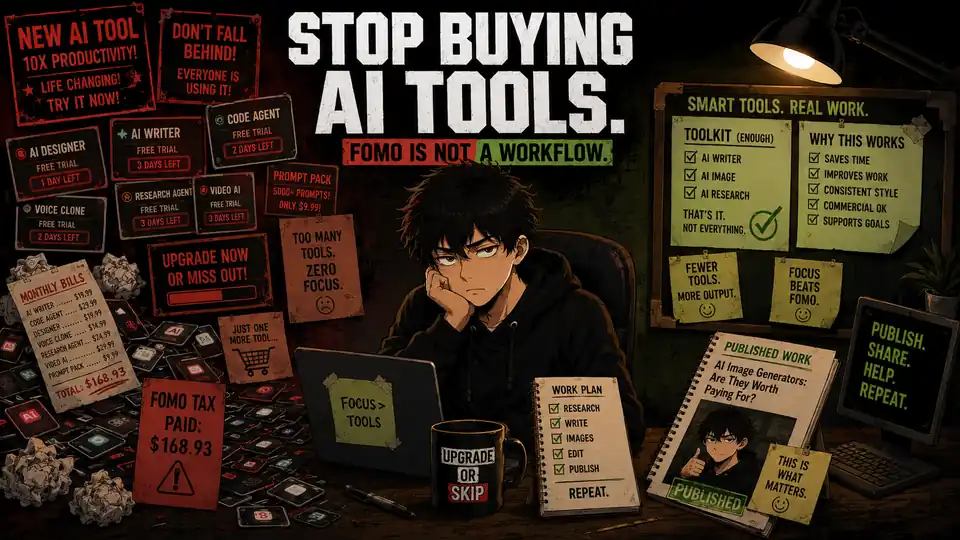
Stop buying AI tools just because everyone else is.
Not because AI is useless.
Not because paid tools are scams.
Not because free tools are always enough.
But because a tool you do not use is not an upgrade.
It is a receipt with branding.
AI FOMO Is A Product Feature Now
AI tools are not only sold as software.
They are sold as relief.
Relief from being behind.
Relief from not knowing enough.
Relief from slow work.
Relief from boring tasks.
Relief from that tiny professional panic that says:
“What if everyone else is getting faster and I am still doing things the old way?”
That feeling is powerful.
And a lot of AI marketing knows it.
You see headlines like:
- Replace your team with AI.
- Build an app in one weekend.
- Automate your entire business.
- Never write from scratch again.
- Stop wasting time.
- Work ten times faster.
- If you are not using this, you are already behind.
Subtle.
Like a brick through a window.
The problem is not that every claim is fake.
Some AI tools really do save time.
Some help people write, code, research, design, summarize, plan, edit, analyze, and create faster.
The problem is that the emotional pitch often arrives before the practical use case.
You buy the feeling first.
Then you look for a reason.
That is backwards.
The Stack Gets Expensive Quietly
One AI subscription rarely feels outrageous.
A $10 tool here.
A $20 assistant there.
A $15 design tool.
A $20 research tool.
A $10 writing add-on.
A $20 coding assistant.
A $10 image generator.
A meeting notes tool you absolutely planned to cancel after the trial.
Of course.
Naturally.
Then one day your “small AI stack” is closer to a phone bill, a gym membership, and a streaming bundle all standing on each other’s shoulders wearing a trench coat.
The annoying part is that none of the individual tools may be bad.
That is what makes the waste harder to notice.
Each one can seem reasonable by itself.
But together, they can overlap badly.
One tool can summarize PDFs.
So can three others.
One tool can draft emails.
So can four others.
One tool can write code.
So can your general AI assistant.
One tool can generate images.
So can the design app you already pay for.
One tool can search the web.
So can the thing you already use every day.
This is how AI spending becomes messy.
Not because you made one terrible purchase.
Because you made seven almost-reasonable ones.
Very human.
Very SaaS.
More Tools Does Not Mean More Capability
There is a difference between having tools and having capability.
A person with one tool they use well can be more capable than a person with six tools they barely understand.
That is especially true with AI.
AI tools reward workflow.
They reward judgment.
They reward repetition.
They reward knowing when to trust, when to verify, when to stop, and when to use something else entirely.
If you keep switching tools every week, you may not be upgrading your work.
You may just be restarting the learning curve over and over.
New interface.
New limits.
New settings.
New prompt style.
New export format.
New pricing page.
New little badge that says “Pro.”
Congratulations.
You have collected another dashboard.
The durable skill is not owning the tool.
The durable skill is knowing how to think with it.
That takes time.
And time split across too many tools becomes thin.
The “Everyone Uses This Now” Trap
One of the worst reasons to buy an AI tool is:
“Everyone is using it.”
Who is everyone?
A Reddit thread?
A YouTube thumbnail?
A founder on X?
A newsletter writer with seven affiliate links and a strong opinion about productivity?
A friend who used it twice and said it was “insane”?
The internet is very good at making a tool look unavoidable for about six weeks.
Then the next unavoidable tool arrives.
This is how people end up with abandoned accounts across half the AI economy.
They were not buying tools.
They were buying permission to stop feeling late.
That is not a workflow.
That is anxiety management with login credentials.
Before buying any AI tool because “everyone uses it,” ask:
Everyone who?
And for what?
If the answer is vague, wait.
A useful tool should survive a week of patience.
If it cannot, it was probably just noise with a pricing page.
The Problem With AI Tool Lists
AI tool lists are useful.
They are also dangerous.
You have seen them:
- 50 AI tools you need in 2026
- 27 AI tools that feel illegal to know
- 100 AI tools to make money while you sleep
- 15 AI tools better than ChatGPT
- The ultimate AI stack for creators
- The only tools you need to automate your life
Very generous.
Very exhausting.
The hidden problem with these lists is that they turn software into collectibles.
You stop asking:
“What problem do I need to solve?”
And start asking:
“Which tools am I missing?”
That is a worse question.
Because there will always be another tool.
Another category.
Another model.
Another launch.
Another “game changer.”
That phrase should be placed in a museum, behind glass, with a warning label.
AI tool lists are good for discovery.
They are bad for decision-making.
Use them like a menu.
Not a shopping list.
The Free Trial Trap
Free trials are not evil.
But they are designed to reduce friction.
That is the point.
You think:
“I will test this later.”
The company thinks:
“Beautiful.”
Then life happens.
You forget.
The trial renews.
Now the tool has passed the most important test in consumer software:
It was slightly inconvenient to cancel.
Very powerful feature.
This is why AI tools should not get casual trials unless you already know what you are testing.
Do not start a trial because the tool looks interesting.
Start a trial because you have a task ready.
A real task.
Something you can finish this week.
For example:
- Rewrite 10 product descriptions.
- Make 3 blog cover concepts.
- Summarize 5 research sources.
- Build one small automation.
- Create one landing page draft.
- Clean one messy spreadsheet.
- Compare one software plan.
- Write one script.
- Prepare one client proposal.
If you do not have a test task, do not start the trial.
You are not evaluating the tool.
You are renting possibility.
Possibility is expensive when billed monthly.
A Tool Should Own A Job
Here is a cleaner way to think about AI subscriptions:
Every paid tool should own a job.
Not a vibe.
A job.
For example:
- ChatGPT owns brainstorming and general drafting.
- Claude owns long-form writing or document review.
- Perplexity owns sourced research.
- Cursor owns coding inside projects.
- Midjourney owns branded visual concepts.
- Canva owns design layouts and publishing graphics.
- Otter owns meeting notes.
- Grammarly owns writing cleanup.
- A VPN owns privacy or location-specific browsing.
- A PDF tool owns editing, signing, compressing, or converting documents.
That kind of stack can make sense.
But if two or three tools are doing the same job, one of them needs to justify itself.
If it cannot, cancel it.
Not because it is bad.
Because it does not own enough work.
This is the simplest subscription audit:
List every AI tool you pay for.
Next to each one, write the job it owns.
If you cannot write a clear job, the tool is on probation.
Cold?
Yes.
Useful?
Also yes.
The “Maybe I’ll Need It Later” Problem
“Maybe I’ll need it later” is how subscriptions survive without earning their keep.
Maybe you will.
But future need does not always justify current payment.
Especially with AI tools, where:
- Features change quickly.
- Free tiers improve.
- Competitors copy each other.
- Bundles appear.
- Your workflow changes.
- Your interest fades.
- The tool you loved in March feels average by August.
Paying now for a possible future task is usually weak logic.
If you can restart the subscription later, cancel it now.
That is not a breakup.
That is a pause button.
The tool will survive.
Probably.
And if it does not, maybe that tells you something.
A Better Rule: The 30-Day Receipt Test
Before renewing an AI subscription, ask:
What happened in the last 30 days because I paid for this?
Not what could happen.
Not what might happen.
Not what the tool can theoretically do.
What actually happened?
Good answers:
- I published four articles faster.
- I created images I used on the site.
- I finished a coding task.
- I saved two hours each week.
- I replaced another paid tool.
- I landed a client.
- I created content that earned traffic.
- I shipped a useful internal workflow.
- I avoided hiring for a small task.
- I improved work I would have done anyway.
Weak answers:
- It is nice to have.
- I might use it soon.
- It feels powerful.
- I like knowing it is there.
- Everyone recommends it.
- I used it once.
- I forgot I had it.
- It was only $20.
Only $20 is how software companies build skyscrapers.
Respect the small leaks.
The Problem Is Not Spending Money
Let’s be clear.
Spending money on tools is not the problem.
Good tools are worth paying for.
A paid AI tool that saves time, improves quality, supports publishing, helps conversion, speeds up research, or helps you make money can be a smart upgrade.
We are not anti-upgrade.
That would be a strange brand decision.
The problem is spending money to reduce anxiety instead of solve a problem.
Those are different purchases.
Buying a tool because it fits your workflow is strategy.
Buying a tool because the internet made you feel behind is emotional damage with an invoice.
Different energy.
Different outcome.
What Real AI Adoption Looks Like
Real AI adoption is usually quieter than the hype.
It does not always look like a giant “AI-powered everything” stack.
It often looks like:
- One assistant used daily.
- One research tool used when sources matter.
- One design tool used for publishing assets.
- One coding tool used for real projects.
- One writing tool used for polish.
- One automation tool used for repeat workflows.
That is enough for many people.
The goal is not to use the most AI.
The goal is to remove friction from work that matters.
If a tool does that, keep it.
If it does not, skip it.
The scoreboard is not:
“How many AI tools do I use?”
The scoreboard is:
“What did I finish?”
When Buying AI Tools Does Make Sense
Upgrade when the tool has a clear role.
A paid AI tool can be worth it if:
- You use it every week.
- It saves measurable time.
- It improves work you actually publish or deliver.
- It replaces another paid tool.
- It helps you earn money.
- It reduces repetitive work.
- It gives you access to features you genuinely need.
- It fits a repeat workflow.
- You understand its limits.
- You would miss it if it disappeared tomorrow.
That last one is useful.
If the tool disappeared tomorrow, would your work get worse?
Would you feel real friction?
Would a project slow down?
Would income, publishing, research, or production suffer?
If yes, maybe it earns its place.
If not, it may just be software furniture.
Nice to have.
Easy to ignore.
Still taking up space.
When You Should Wait
Waiting is underrated.
In AI, waiting can be smart because the market changes fast.
Today’s paid feature may become tomorrow’s free tier.
Today’s standalone tool may become part of a larger app.
Today’s impressive demo may become next month’s abandoned product.
Today’s “must-have” wrapper may become unnecessary when the base model adds the feature natively.
This happens constantly.
So if you are unsure, wait.
Let the hype cool down.
Let real users complain.
They will.
Patiently.
With screenshots.
Watch what people still use after the launch wave fades.
The tools that survive normal work are more interesting than the tools that win launch week.
The Social Proof Problem
Reviews and community feedback matter.
But they need context.
A tool can be amazing for a developer and useless for a blogger.
Great for a designer and irrelevant for a student.
Perfect for a sales team and pointless for someone writing one article a week.
When reading recommendations, ask:
- What does this person do?
- Are they using the tool daily?
- Are they earning from it?
- Are they showing real output?
- Are they comparing it to alternatives?
- Are they being paid or using affiliate links?
- Are they describing limits, or only miracles?
A useful review includes trade-offs.
A suspicious review sounds like the tool got baptized.
Be careful with miracles.
They often have checkout pages.
AI Tools Should Serve The Work
This is the core point of the whole series.
AI tools should serve the work.
Not the other way around.
If you find yourself constantly reorganizing your workflow around new tools, stop.
The work comes first.
The tool comes second.
For Upgrade or Skip, the work is clear:
- Build content assets.
- Earn search traffic.
- Build trust.
- Help readers make better decisions.
- Connect useful articles to real monetization.
- Avoid fake testing.
- Avoid low-quality spam.
- Turn good content into long-term value.
That is the work.
Any tool that helps this work can be considered.
Any tool that distracts from it gets cut.
Very simple.
Not always easy.
Still simple.
The AI Tool Audit
Here is the audit I would use before paying for another AI tool.
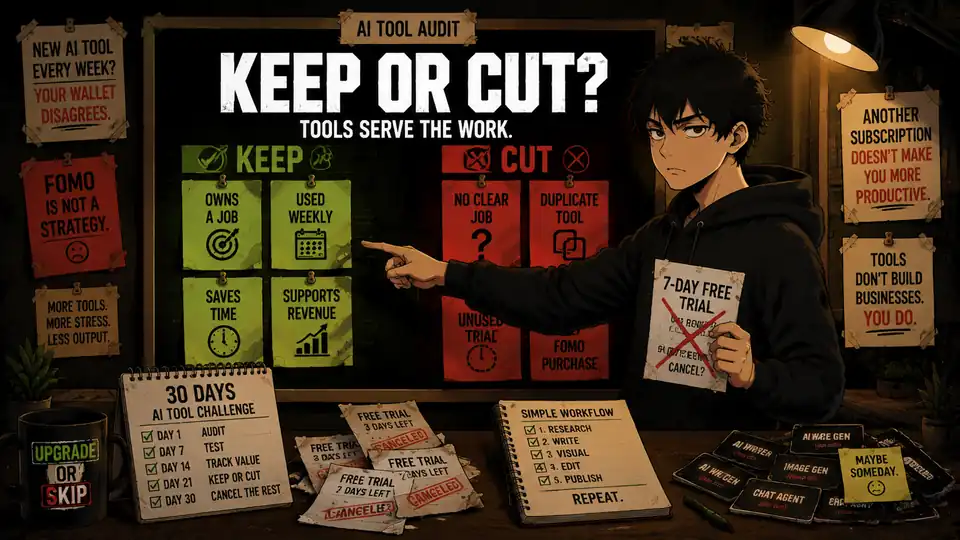
Ask these questions:
- What problem does this tool solve?
- Do I have that problem every week?
- What tool am I currently using for that job?
- Is this meaningfully better?
- Does it replace something I already pay for?
- Will I use it in the next seven days?
- What output will prove it was useful?
- Can I cancel easily?
- Do I understand the limits and pricing?
- Would I still want it if nobody online was talking about it?
That last question hurts.
Good.
It should.
If the answer is no, skip it.
You do not need another subscription to prove you are modern.
You need tools that help you finish.
The Best Stack Is Usually Smaller Than You Think
A good AI stack is not the biggest one.
It is the one you actually use.
For many people, the best stack might be:
- One general assistant
- One specialized work tool
- One creative or design tool
- One research or productivity tool if truly needed
That is plenty.
For others, especially developers, marketers, designers, or teams, a larger stack can make sense.
But the logic should be deliberate.
Not accidental.
Not “I saw a thread.”
Not “everyone says this is insane.”
Not “I might need it.”
Your stack should look like your work.
If your stack looks like your anxiety, start cutting.
Upgrade If:
Upgrade to a new AI tool if:
- You have a clear recurring problem.
- The tool solves that problem better than what you already use.
- You will use it within the next seven days.
- It saves time, improves quality, or supports revenue.
- It replaces another subscription or owns a specific job.
- You understand the pricing and cancellation terms.
- You can measure whether it helped after 30 days.
- You are buying utility, not relief from FOMO.
Skip If:
Skip the AI tool if:
- You only want it because everyone is talking about it.
- You cannot name the job it owns.
- You already pay for a tool that does the same thing.
- You are starting a free trial without a real test task.
- You mostly want to feel caught up.
- You have not used your current tools well yet.
- The tool creates more dashboards than output.
- You would not buy it if it were not trending.
The Upgrade or Skip Take
AI tools can be worth paying for.
But the best AI tool is not the one with the loudest launch, the prettiest demo, or the most dramatic YouTube thumbnail.
It is the one that helps you do real work.
If a tool saves time, improves output, supports publishing, helps you earn, or removes a repeated bottleneck, upgrade.
If it mostly makes you feel less behind, skip it.
That feeling will come back anyway.
Probably with a new logo.
The first AI series on Upgrade or Skip has not been about rejecting AI.
It has been about refusing to buy panic.
AI can be useful.
AI can be powerful.
AI can be worth paying for.
But only when it serves the work.
Not the anxiety.
Next up:
Grammarly Pro Review 2026: Is It Actually Worth Paying For?
Next, we are moving from broad AI subscriptions into practical software tools people actually pay for: writing apps, VPNs, PDF tools, design software, video editors, and everyday online services.
We will start with Grammarly and ask the question that matters:
When is better writing help worth a monthly bill?
Upgrade smarter. Skip louder.