Disclosure: This post may contain affiliate links. If you buy through them, we may earn a small commission at no extra cost to you.
Welcome back to Upgrade or Skip.
In the last post, we talked about AI coding tools and whether they are a real productivity boost or just expensive autocomplete.
Now we are moving from code to images.
Which sounds more fun.
Less debugging.
More dragons.
More fake product photos.
More “I just need one quick thumbnail” turning into 47 generations, 12 prompt tweaks, and a monthly subscription you forgot to cancel.
Very artistic.
Very recurring.
AI image generators are one of the easiest AI tools to justify emotionally.
You type a prompt.
Something appears.
It feels like magic.
Then you try to make the same character appear twice.
Or fix one hand.
Or remove weird text.
Or make the image usable for a real blog, product page, ad, thumbnail, or client project.
Suddenly the magic starts asking for credits.
So the real question is not:
Can AI image generators make impressive images?
They can.
The better question is:
Are AI image generators actually worth paying for, or are you just buying prettier drafts you still have to fix?
What AI Image Generators Actually Do Well
AI image generators are very good at one thing:
Fast visual exploration.
They can help you quickly test:
- Blog cover ideas
- YouTube thumbnail directions
- Social media concepts
- Mood boards
- Poster styles
- Character directions
- Product mockup ideas
- Backgrounds
- Abstract visuals
- Presentation graphics
- Ad concepts
- Early design drafts
This is where the value is real.
Before AI image tools, getting 20 visual directions usually meant searching stock libraries, sketching, hiring a designer, or giving up and using the same blue gradient everyone else used.
The internet survived.
Barely.
Now you can move from:
“I have no visual idea.”
to:
“This direction might actually work.”
in minutes.
That does not mean every output is usable.
But for creators, bloggers, marketers, and small business owners, that speed can be genuinely useful.
Not because AI replaces taste.
Because it gives taste something to react to.
The Problem: Pretty Is Not The Same As Useful
AI image tools are excellent at making something look impressive for three seconds.
That is not the same as making something useful.
A useful image needs to fit the job.
For a blog, it needs to match the article.
For a brand, it needs to stay consistent.
For a thumbnail, it needs to be readable when it is tiny.
For an ad, it needs to communicate quickly.
For a product page, it needs to avoid misleading people.
For a serious business, it needs to look professional without becoming generic AI sludge.
And this is where many AI images fail.
They look detailed.
They look expensive.
They look like they belong in a product launch video for a company that uses the word “empower” too much.
But they do not always say anything.
That is the trap.
You are not paying for pixels.
You are paying for usable visual decisions.
If the tool gives you beautiful images that do not fit your brand, audience, or purpose, it is still wasted time.
Just prettier wasted time.
Free AI Image Generators Are Better Than Before
The free options are no longer useless.https://www.adobe.com/products/firefly.html
That matters.
Many general AI tools now include some level of image generation, usually with tighter usage limits or fewer advanced features than paid plans.
The important part is simple:
You do not have to pay immediately.
If you only need occasional images, free access may already be enough.https://www.adobe.com/products/firefly.html
Especially for things like:
- A quick blog concept
- A social media image
- A rough mood board
- A visual idea
- A test thumbnail
- A personal project
- A non-commercial experiment
Free image generation is often enough to answer the first question:
Do I even need this workflow?
Find that out before adding another monthly charge.
Let the tool prove it belongs in your bank statement.
Paid Plans Mostly Sell Three Things
Most paid image-generation plans are really selling some combination of three things:
More generations. Better workflow. More confidence for serious use.
Paid plans typically give you more credits, more monthly usage, faster generation, higher limits, or additional generation modes.
That is useful if you create often.
It is dangerous if you mostly generate because you are bored.
There is a difference.
More generations do not automatically mean more useful images.
Sometimes they just mean you can reject 83 images instead of 12.
Progress.
Technically.
This is where paying can become much easier to justify.
For real work, the important questions are not:
“Can this tool make something beautiful?”
They are:
- Can I keep the same character?
- Can I reuse a visual style?
- Can I edit only one part?
- Can I export the size I need?
- Can I control the composition?
- Can I avoid broken text?
- Can I create a repeatable workflow?
- Can I use the output commercially under the applicable terms?
Those questions are boring.
Boring questions are where money hides.
A tool that helps you reliably produce one usable image is worth more than a tool that gives you 100 impressive accidents.
If you use AI-generated images for a business, licensing and usage terms matter.
Different tools and plans can have different rules around commercial use, privacy, public generations, credits, and other restrictions.
This is not the fun part.
It is also not optional when you are using images for:
- Websites
- Advertising
- Client work
- Products
- Packaging
- Monetized content
The more public and commercial the use case, the more carefully you should check the current terms.
Do not assume “I generated it” automatically answers every rights question.
The “Just One More Generation” Trap
AI image tools have a special kind of subscription trap.
With writing, you usually know when you are close to finished.
The paragraph works.
Or it does not.
Images are different.
There is always another possibility.
One more generation.
One more prompt.
One more style.
One more variation.
One more attempt to fix that hand.
One more attempt to make the text readable.
One more attempt to make the character look like the same person from the previous image.
Then an hour disappears.
Maybe two.
You did not “create visuals.”
You negotiated with a slot machine wearing a designer scarf.
That is why image generators can feel productive even when they are not.
They create visible output.
Visible output feels like progress.
But if none of those images get published, used, sold, tested, or shipped, the tool did not save you time.
It made your indecision more entertaining.
When Paying Makes Sense For Bloggers
For bloggers, AI image generators can absolutely be worth paying for.
But only when images are part of your publishing system.
Not decoration.
System.
A paid tool becomes easier to justify if you publish consistently and need:
- Blog cover images
- Social thumbnails
- Pinterest-style graphics
- Comparison visuals
- Concept images
- Series branding
- Featured images
- Simple diagrams
- Reusable character or mascot visuals
A blog that publishes regularly needs visuals.
Stock images become generic fast.
Screenshots are useful for software articles, but they do not always build a recognizable visual identity.
Custom illustrations can.
But there is one big condition:
Consistency.
If every article has a different face, different art style, different palette, and different visual language, you are not building a brand.
You are generating random posters.
Pretty random posters.
But still random.
When Paying Makes Sense For Small Businesses
For small businesses, paid AI image tools can be useful when they remove an actual design bottleneck.
Good use cases include:
- Social media campaigns
- Landing page concepts
- Ad creative drafts
- Product mockups
- Presentation visuals
- Blog images
- Email graphics
- Brand mood boards
- Simple promotional visuals
But small businesses should be careful.
AI images can make a brand look cheap even when the images themselves look expensive.
The problem is not always quality.
Sometimes it is sameness.
Too many AI business images have the same glossy lighting, fake depth, dramatic expressions, and motivational-poster energy.
You know the look.
Everyone is empowered.
Nobody has pores.
If your brand depends on trust, clarity, or credibility, do not use AI images simply because they look impressive.
Use them because they communicate better.
That is a different standard.
When Paying Makes Sense For Creators
For creators, AI image generators make sense when visuals directly support output.
Examples include:
- YouTube thumbnails
- Newsletter graphics
- Digital products
- Course slides
- Podcast covers
- Social campaigns
- Concept art
- Character exploration
- Mockups
- Brand assets
If images help you publish more often, test ideas faster, or earn money, paying can be justified.
But creators are also vulnerable to the content treadmill.
A better image does not fix a weak idea.
A cinematic thumbnail does not make a boring video useful.
A beautiful cover does not make a thin article valuable.
Images support the content.
They do not replace the content.
That sentence should be printed on every AI image pricing page in extremely readable text.
Which it will not be.
For business reasons.
When You Should Skip Paying
Skip a paid AI image generator if:
- You generate images only occasionally.
- You rarely publish what you generate.
- You use it mostly for fun.
- You already have enough visuals from screenshots, product pages, or stock sources.
- You cannot keep a consistent style.
- You spend more time prompting than creating.
- You keep paying because you might need it “soon.”
- You do not understand the usage rights.
- You are not using the images for anything that earns, saves, or supports real work.
Here is the harsh little truth:
If you only generate a few images a month, a dedicated subscription may be overkill.
Use free access.
Use pay-as-you-go options where appropriate.
Use an AI or design subscription you already pay for if it includes enough image generation.
Use screenshots when screenshots are more useful.
Use official press images when their terms allow it.
Do not pay for a dedicated image generator just because the internet made it feel like every creator needs one.
Every creator also apparently needs a ring light, three newsletters, a course funnel, and a microphone arm.
The internet has needs.
You have a budget.
The Consistency Problem
One of the biggest problems with AI image generators is consistency.
A single image can look great.
A series is harder.
For a brand, consistency matters more than one impressive output.
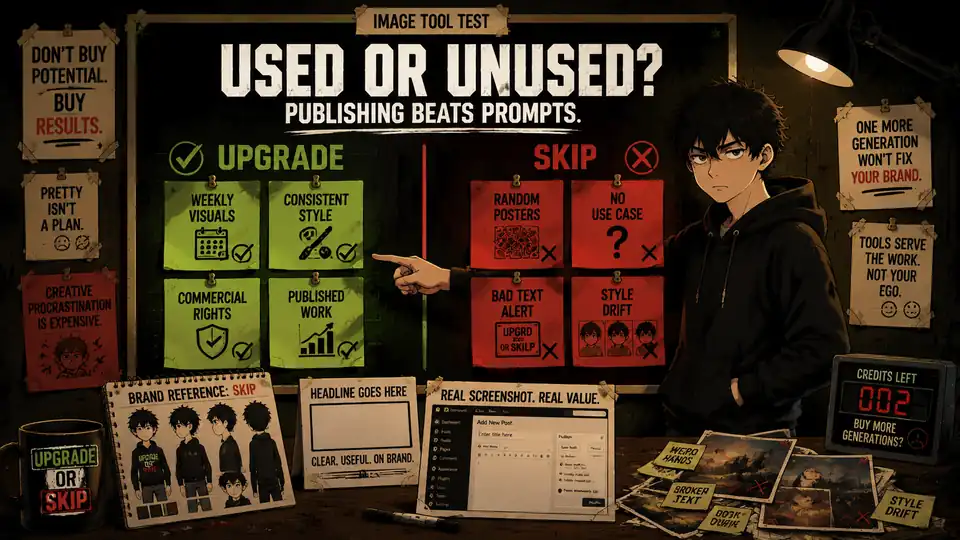
You need:
- The same character
- The same face
- The same style
- The same color palette
- The same composition language
- The same image mood
- The same level of detail
- The same typography approach
- The same brand purpose
Many AI tools still require reference images, careful prompting, reusable visual rules, or post-editing to maintain that consistency.
That is why paying is not enough.
The tool still needs a visual system.
Without one, you get variety.
Variety is fun.
Branding is not variety.
Branding is remembering who you are while the tool keeps offering you cooler strangers.
The Text Problem
AI image tools have become better at generating text.
Better does not mean reliable.
That matters when creating:
- Blog covers
- Thumbnails
- Posters
- Ads
- Product images
- Infographics
- Comparison visuals
If exact wording matters, the safer workflow is often:
- Generate the main artwork with little or no text.
- Leave intentional space for the headline.
- Add the final text afterward in a proper design or editing tool.
That gives you control.
It also prevents your beautiful new blog cover from proudly announcing:
“UPGRAD OR SKLIP.”
A bold message.
Not quite ours.
The Copyright And Trust Problem
AI-generated images also create a trust question.
Not every reader cares.
Some do.
If you use AI images heavily, ask yourself:
Do they make the site feel original?
Or synthetic?
Do they clarify the article?
Or merely decorate it?
Do they strengthen the brand?
Or make the reader wonder whether the entire site was mass-produced?
There is no universal answer.
AI images can make a site feel more polished.
They can also make it feel less human.
The difference is editorial judgment.
If the image supports a clear idea, it helps.
If it looks like filler, it hurts.
For Software Articles, Screenshots Still Matter
This becomes especially important when covering software.
If you write about AI tools, VPNs, PDF editors, design software, video editors, or online services, branded illustrations are useful.
But real screenshots matter too.
A software article containing nothing but AI artwork can feel detached from the actual product.
A stronger combination is:
- One strong branded cover image
- Real screenshots where they help explain the product
- Clear evidence for important free-versus-paid differences
That gives you both sides.
AI illustration for identity.
Screenshots for reality.
Readers need both.
The Upgrade Test
Before paying for an AI image generator, ask one question:
What image problem am I solving every month?
Not once.
Every month.
Good answers:
- I publish weekly blog posts and need consistent covers.
- I create YouTube thumbnails regularly.
- I run ads and need concept testing.
- I make client visuals.
- I sell digital products.
- I need fast mood boards for projects.
- Images are part of my business workflow.
- I can turn the outputs into traffic, trust, or revenue.
Weak answers:
- It looks cool.
- Everyone is using it.
- I might need it later.
- I want to play with prompts.
- I generated one amazing image last week.
- I feel more creative with it open.
Fun is allowed.
Just do not confuse fun with a business expense.
Unless your business is fun.
In which case, congratulations.
Also still check the bill.
Upgrade If:
Upgrade to a paid AI image generator if:
- You create visuals every week.
- You publish images as part of your blog, brand, channel, or business.
- You need consistent covers, thumbnails, ads, or social graphics.
- The paid plan gives you meaningfully better workflow, rights, privacy, speed, or style control.
- You can point to images you actually published or used.
- The tool saves time compared with searching stock libraries or designing manually.
- You understand the commercial usage terms.
- The subscription supports traffic, trust, sales, or client work.
Skip If:
Skip the paid plan if:
- You only generate images occasionally.
- You mostly use it for fun.
- Free tools already cover your needs.
- You already pay for a tool that includes enough image generation.
- You keep generating but rarely publish anything.
- You cannot get consistent results.
- You need exact text inside images and still have to fix everything afterward.
- You do not understand the licensing or commercial rights.
- The subscription is mostly creative procrastination with better lighting.
The Upgrade or Skip Take
AI image generators can be worth paying for.
But not because they are magical.
They are worth paying for when they become part of a real publishing, branding, marketing, or creative workflow.
If you use them to create visuals that actually get published, tested, sold, or used, a paid plan can make sense.
If you use them to generate endless almost-good images that never leave your downloads folder, skip the subscription.
That is not creativity.
That is a very beautiful waiting room.
For most casual users, free tools or existing AI subscriptions are enough.
For serious creators, bloggers, marketers, and small businesses, paid image tools can be valuable when they solve a repeated problem.
The image is not the product.
The useful decision is the product.
Next Up:
Stop Buying AI Tools Just Because Everyone Else Is
Next, we will close this first AI series with the biggest trap of all:
Buying AI tools because the internet makes you feel behind, not because your actual work needs them.
Upgrade smarter. Skip louder.