
Welcome back to Upgrade or Skip.
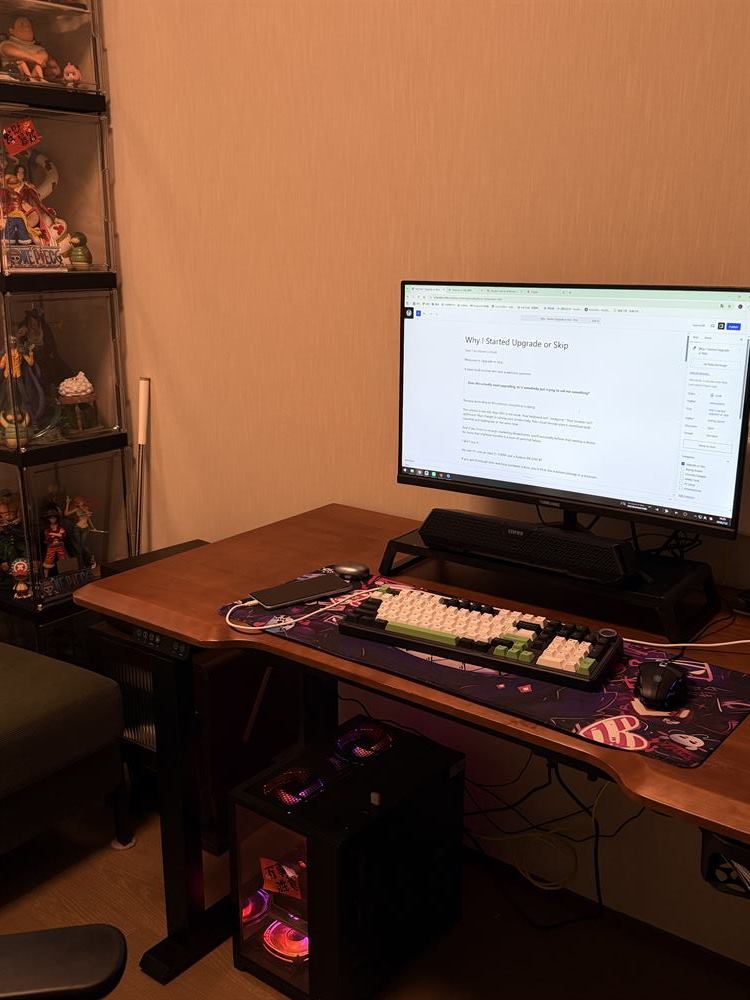
In the last few posts, I talked about my own PC and the RX 6700 XT that powers it.
But those articles were never really about one CPU or one graphics card.
They were about something bigger.
Maybe your PC is not obsolete.
Maybe your expectations changed.
Or more accurately:
Maybe your expectations were changed for you.
Because that is the part nobody likes to admit.
A lot of people do not wake up one morning and naturally decide their computer is worthless.
They are taught to feel that way.
A new GPU launches.
A new CPU benchmark appears.
A new “minimum spec” discussion starts.
A new YouTube thumbnail screams that your system is holding you back.
A new game arrives with settings so expensive they should require financing.
And suddenly, the machine that worked perfectly yesterday starts feeling like a problem.
Not because it stopped working.
Because the room got louder.
Obsolete Is a Convenient Word
“Obsolete” sounds technical.
It sounds serious.
It sounds like something has reached the end of its useful life.
Sometimes that is true.
A laptop with a dying battery, broken keyboard, no security updates, and a screen held together by emotional support tape is probably not a long-term investment.
But a lot of the time, “obsolete” just means:
A newer thing exists.
That is not the same thing.
Your PC did not become obsolete because a faster GPU launched.
Your monitor did not become obsolete because someone on Reddit decided 144Hz is now peasant behavior.
Your keyboard did not become obsolete because it lacks a tiny screen, a knob, and a marketing department whispering the word “creator.”
Newer is not the same as necessary.
Faster is not the same as useful.
And “not the best anymore” is not the same as broken.
The Internet Changed the Baseline
The weird thing about PC hardware is that the online baseline keeps moving.
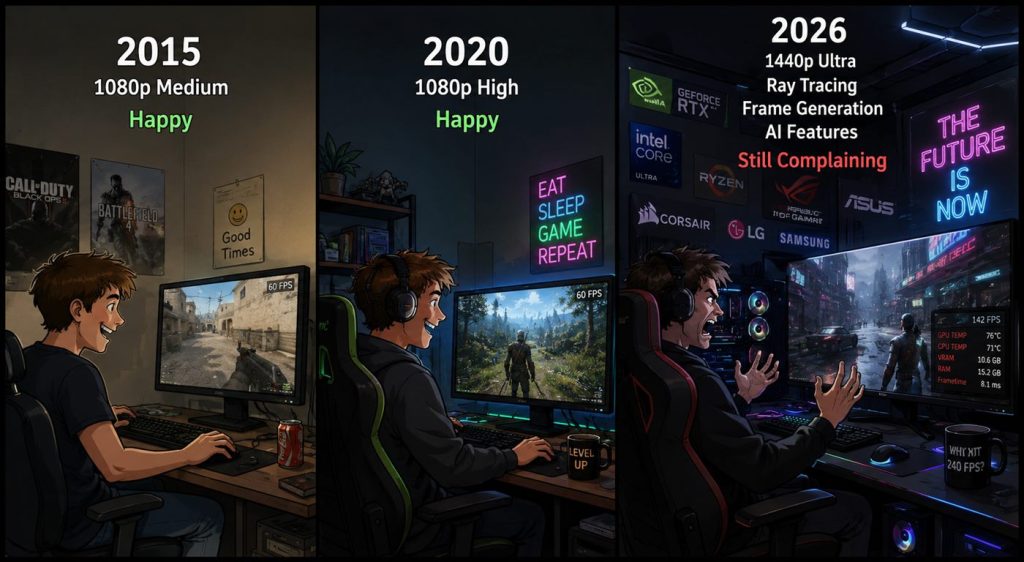
Years ago, running a game smoothly was enough.
Then 60 FPS became the floor.
Then 144 FPS became normal.
Then 1440p became the sweet spot.
Then ray tracing became the future.
Then frame generation became the conversation.
Then AI-ready became a sticker people started slapping on everything like seasoning.
None of these things are bad by themselves.
Higher frame rates can feel better.
Better monitors can absolutely improve the experience.
New graphics features can look impressive.
The problem starts when optional improvements get marketed like survival requirements.
That is how a perfectly good PC becomes “old” without changing at all.
The hardware stayed the same.
The expectations moved.
And every time the baseline moves, someone is ready to sell you the solution.
Convenient.
Ultra Settings Are Not a Human Right
One of the biggest traps in PC gaming is treating Ultra settings like the default.
They are not.
Ultra settings are often a stress test wearing a nice outfit.
Sometimes they look better.
Sometimes they barely look different.
Sometimes they eat performance like they have been training for it.
A lot of people think their PC is aging badly when what is actually happening is simpler:
They are asking old hardware to run new games at settings designed to punish new hardware.
That is not always a hardware failure.
Sometimes that is just the settings menu trying to start a fight.
High settings are usually fine.
Medium settings are not a personal failure.
Turning down shadows will not make your ancestors disappointed.
And if dropping one or two expensive settings gives you a smoother experience, that is not “coping.”
That is using the computer like an adult.
When Your PC Is Actually Too Old
Now, this is not a “never upgrade” argument.
That would be just as dumb as upgrading every time a company changes the box color.
Sometimes your PC really is too old for what you want to do.
Upgrade if:
- Your games no longer run at a frame rate you can tolerate.
- You have to lower settings so far that the experience stops being enjoyable.
- Your work is being slowed down in a way that costs time or money.
- Your hardware is unstable, overheating, crashing, or failing.
- You need features your current system does not support.
- You have moved to a higher-resolution monitor and your GPU cannot keep up.
- Your storage, memory, or CPU is creating obvious daily friction.
Those are real reasons.
Not glamorous reasons.
Not thumbnail reasons.
Real ones.
A good upgrade solves a real problem.
A bad upgrade mostly solves anxiety.
When You Should Probably Skip
On the other hand, you probably do not need to upgrade just because:
- A new generation launched.
- A benchmark chart made your PC look smaller.
- Someone called your hardware “old” online.
- A game recommends hardware you do not have, but still runs fine.
- You are bored and calling it “future-proofing.”
- You want to buy performance you will not actually notice.
- You are comparing your setup to people who treat PC parts like a competitive sport.
That last one is especially dangerous.
There is always someone online with a faster PC.
There is always someone with a cleaner setup.
There is always someone with more RGB, more monitors, more fans, more acronyms, and less visible evidence of financial restraint.
That does not mean your machine is bad.
It means the internet is very good at making normal things feel inadequate.
The “Future-Proof” Trap
Future-proofing is one of the most abused ideas in tech.
In theory, it makes sense.
Buy something decent now so you do not have to replace it immediately.
That is reasonable.
But in practice, “future-proof” often becomes a permission slip to overspend.
A better PSU?
Maybe smart.
More VRAM?
Often useful.
Enough RAM for your workload?
Reasonable.
Buying far beyond your needs because a stranger promised it would protect you from time?
That is where things get silly.
The future has a habit of ignoring your invoice.
New standards appear.
Game engines change.
Software gets heavier.
Prices move.
Your actual needs change.
And sometimes the “future-proof” thing you bought turns out to be overkill for three years, then weirdly outdated in the fourth.
Future-proofing is not fake.
But it is not magic either.
The goal is not to buy the most expensive thing you can justify.
The goal is to buy enough performance for your real use, with a little room to breathe.
A little room.
Not an aircraft hangar.
Your PC Is a Tool, Not a Personality Test
This is where the conversation gets strange.
People start treating hardware like identity.
Nvidia or AMD.
Intel or AMD.
Console or PC.
1080p or 1440p.
Air cooling or liquid cooling.
Mechanical keyboard or shame.
It gets exhausting.
Your PC is not a confession.
It is not a moral statement.
It is a tool.
A machine.
A pile of parts that should help you play games, work, create, study, browse, edit, stream, argue online, or whatever else you actually use it for.
If it does that well, then it is doing its job.
Even if a newer machine would do it faster.
Even if your GPU is not trendy.
Even if your CPU is no longer invited to benchmark parties.
The question is not whether your PC is impressive.
The question is whether it still serves you.
The Upgrade or Skip Rule
Here is the rule I am trying to use for this site:
Do not upgrade because something new exists.
Upgrade because something you actually do has become worse, slower, harder, or more annoying than you are willing to accept.
That is it.
That rule works for PCs.
It works for phones.
It works for software.
It works for subscriptions.
It works for AI tools, VPNs, cloud storage, keyboards, monitors, earbuds, chargers, and every other product trying to convince you that yesterday’s purchase is already embarrassing.
The burden of proof belongs to the upgrade.
Not the thing you already own.
Final Thoughts
Your PC might be obsolete.
Maybe it really is time.
Maybe your games run badly.
Maybe your work is slow.
Maybe your hardware is failing.
Maybe your needs changed.
If so, upgrade.
No guilt.
No drama.
But if your computer still does what you need, and the only real problem is that the internet has made you feel behind, then maybe the smartest move is simpler:
Skip.
Not forever.
Just until there is a real reason.
Because a lot of upgrade advice is not really about helping you.
It is about making normal hardware feel inadequate.
And once you notice that, it becomes much easier to ask the only question that matters:
Is this actually improving my life, or is somebody just trying to sell me a shinier box?
Next Up
Is 16GB RAM Still Enough in 2026?
Next up, we stop talking about philosophy and start talking about decisions.
Real products.
Real upgrades.
Real trade-offs.
Starting with one of the most common panic questions in PC gaming:
Is 16GB RAM Still Enough in 2026?
Upgrade smarter. Skip louder.