
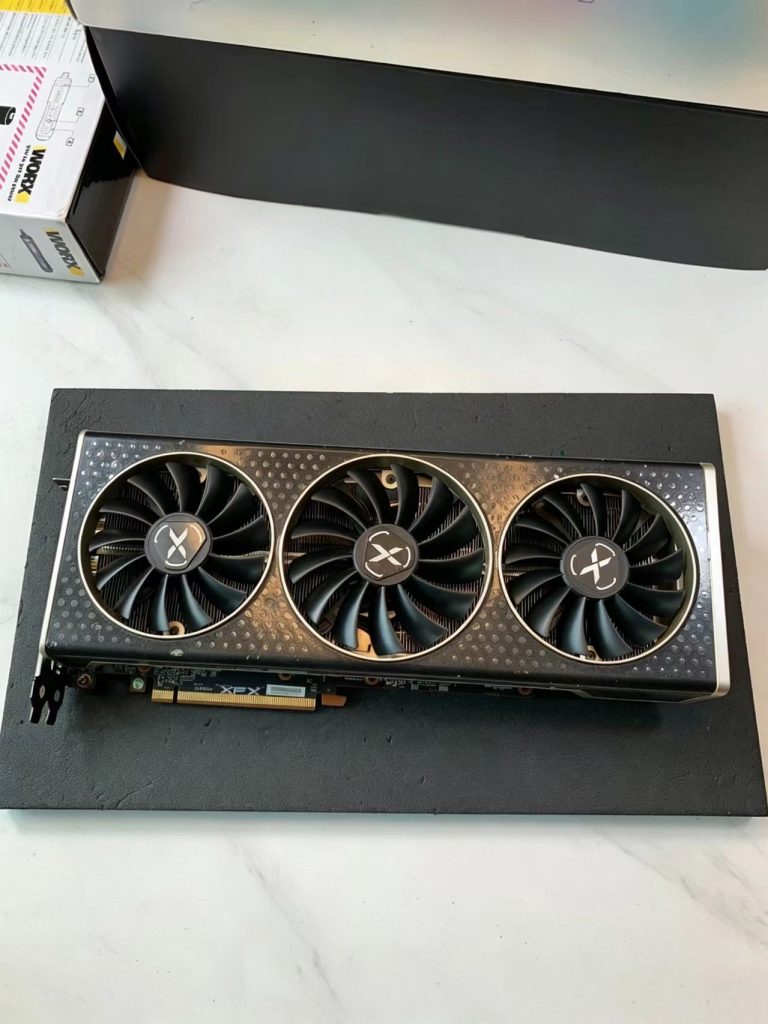
Five years later, AMD’s mid-range survivor is still making upgrade marketing uncomfortable.
Welcome back to Upgrade or Skip.
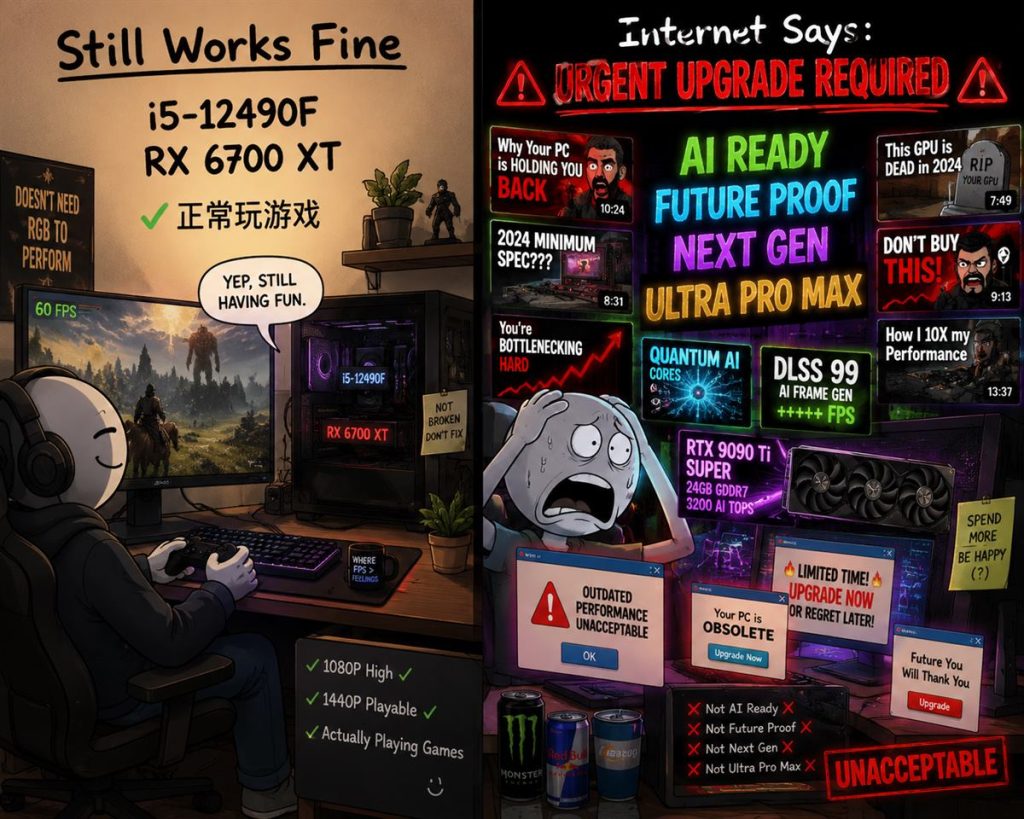
In the last post, I talked about my own supposedly obsolete PC: an Intel i5-12490F paired with a Radeon RX 6700 XT.
That article was about the whole machine.
This one is about the part that makes the internet argue like someone unplugged the router during a ranked match:
The RX 6700 XT.
But this is not another benchmark chart pretending to be a personality.
There are already enough of those.
This is about something more interesting:
Why did a mid-range GPU from 2021 survive longer than a lot of upgrade culture seemed to expect?
Because by the normal rules of online hardware discourse, this card should be dead.
It launched.
Newer cards arrived.
Marketing departments discovered new buzzwords.
YouTube thumbnails got redder.
And somehow, the RX 6700 XT kept doing the one thing that makes upgrade pressure extremely inconvenient:
Playing games.
The Upgrade Prediction Problem
Every GPU generation comes with two messages.
The new card is future-proof.
The old card is suddenly a problem.
Convenient.
Very tidy.
Almost like someone benefits when perfectly usable hardware starts feeling emotionally expired.
The RX 6700 XT is a good example of why that logic deserves suspicion.
It was not a flagship.
It was not the fastest card of its generation.
It did not have the cleanest ray tracing story.
It did not come wrapped in a magical promise that it would carry civilization into the next decade.
It was simply a strong 1440p gaming card with 12GB of VRAM.
At the time, that sounded normal.
In 2026, it looks smarter than expected.
Not because the card became legendary overnight.
Because a lot of newer “mid-range” products made 8GB feel a little too optimistic.
12GB Was Not Sexy. It Was Useful.
This is the part where the RX 6700 XT accidentally becomes annoying.
Not exciting.
Not revolutionary.
Annoying.
Because 12GB of VRAM is not a glamorous feature.
Nobody buys a GPU, stares lovingly at the box, and whispers:
“Ah yes, memory headroom.”
But years later, that boring specification starts mattering.
In 2021, 12GB looked like a nice bonus.
In 2026, it looks like one of the reasons this card is still standing.
That does not mean VRAM solves everything.
Extra memory does not turn an older GPU into a new one.
It does not fix weak ray tracing.
It does not summon free performance from the walls.
But it does help the card avoid one of the worst modern PC gaming experiences:
Opening the settings menu and realizing your GPU is not out of power yet, but it is already out of room.
That is the real lesson.
Sometimes “future-proof” is not some mystical marketing spell.
Sometimes it simply means the hardware had enough breathing room to age normally.
Fine Wine, But Calm Down
AMD fans love the phrase “Fine Wine.”
Sometimes they have a point.
Older Radeon cards have occasionally aged better than expected because of driver improvements, game optimization, API changes, and memory capacity.
But let’s not start lighting candles around the PCIe slot.
The RX 6700 XT did not become immortal.
It did not secretly evolve into a next-generation card while everyone was sleeping.
What happened is much simpler.
Games got heavier.
8GB cards started looking more nervous.
The RX 6700 XT still had 12GB.
That is not magic.
That is math with good timing.
And sometimes “Fine Wine” is just another way of saying people finally stopped treating Ultra settings like a constitutional right.
The Part Marketing Hates
The funniest thing about older hardware is that it creates an uncomfortable question:
What if you do not need to upgrade yet?
Not:
“What if the new thing is faster?”
Of course it is faster.
That is how time works.
The real question is:
Does the difference matter enough for your actual life?
For many RX 6700 XT owners, the answer is still no.
If you play at 1080p, the card is often more than enough.
If you play at 1440p and can behave like an adult around the settings menu, it still has plenty of life left.
If you are willing to lower the settings that barely change the image but somehow consume half the GPU, it keeps going.
That is the part upgrade culture hates.
Because “still good enough” is terrible for sales.
If the thing you already own still does the job, the upgrade needs to prove why it belongs.
Where the Card Really Shows Its Age
Now, before anyone starts printing RX 6700 XT memorial coins, let’s be honest.
This card has limits.
Ray tracing is not its strength.
If your idea of gaming is enabling every lighting feature until your GPU starts writing a resignation letter, this is not your card.
Heavy 4K gaming is not the point either.
Newer cards are better for modern upscaling technologies, frame generation, creator workloads, AI features, and power efficiency.
And yes, AMD driver complaints still exist.
Some people have experienced black screens, driver timeouts, weird game-specific issues, and the usual PC gaming nonsense that occasionally reminds you why consoles were invented.
But those limitations do not erase the bigger point.
A product can be imperfect and still not need replacing.
That sentence alone could bankrupt half the internet’s upgrade advice industry.
What the RX 6700 XT Teaches Us
The lesson is not:
Everyone should buy an RX 6700 XT.
That would be stupid.
The lesson is:
Useful hardware usually stays useful longer than the internet wants to admit.
The RX 6700 XT survived because it had enough performance, enough memory, and enough practical value to outlive several rounds of “you need to upgrade now” noise.
It is not special because it is flawless.
It is special because it demonstrates a very ordinary truth that people keep forgetting:
If the thing you already own still does the job, the upgrade needs to prove why it belongs.
Upgrade or Skip?
If you already own an RX 6700 XT, I would not upgrade simply because newer cards exist.
That is not a reason.
That is a calendar.
Upgrade because your needs changed.
Not because the calendar did.
Upgrade if:
- You want serious ray tracing performance.
- You are moving to 4K gaming.
- A specific game is clearly holding your system back.
- You need CUDA, AI tools, creator workflows, or Nvidia-specific features.
- Your card is unstable, overheating, or dying.
Those are real reasons.
A YouTube thumbnail with red arrows is not.
If your games still run well, your settings are sensible, and your actual experience is fine, then the smarter move may be simple:
Skip.
Not forever.
Just for now.
Final Thoughts
The RX 6700 XT did not become immortal.
It simply aged better than a lot of fear-marketing wanted it to.
It is not a legend.
It is not trash.
It is not the answer for everyone.
It is simply a graphics card that launched with enough performance, enough memory, and enough common sense to survive longer than many people expected.
And honestly, that is more impressive than most marketing campaigns.
Because the real question was never:
“Is there something faster?”
Of course there is.
There is always something faster.
The real question is:
“Does faster matter enough for me to pay for it?”
For a lot of RX 6700 XT owners in 2026, the answer is still:
No.
And that is why this remains a Skip-the-Upgrade card.
Next Up
Your PC Isn’t Obsolete. Your Expectations Changed.
Because this was never really about one graphics card.
It was about something much bigger.
The internet loves calling hardware obsolete.
Reality is usually less dramatic.
Upgrade smarter. Skip louder.
1 thought on “The GPU That Refused to Die: RX 6700 XT in 2026”