
Welcome back to Upgrade or Skip.
In the last post, I argued that before buying a new GPU, most people should try something radical:
Lower a few settings.
Very brave. Very controversial. Somewhere on the internet, a benchmark chart just fainted.
Naturally, the internet did not approve.
Now we move to the next panic trigger:
VRAM.
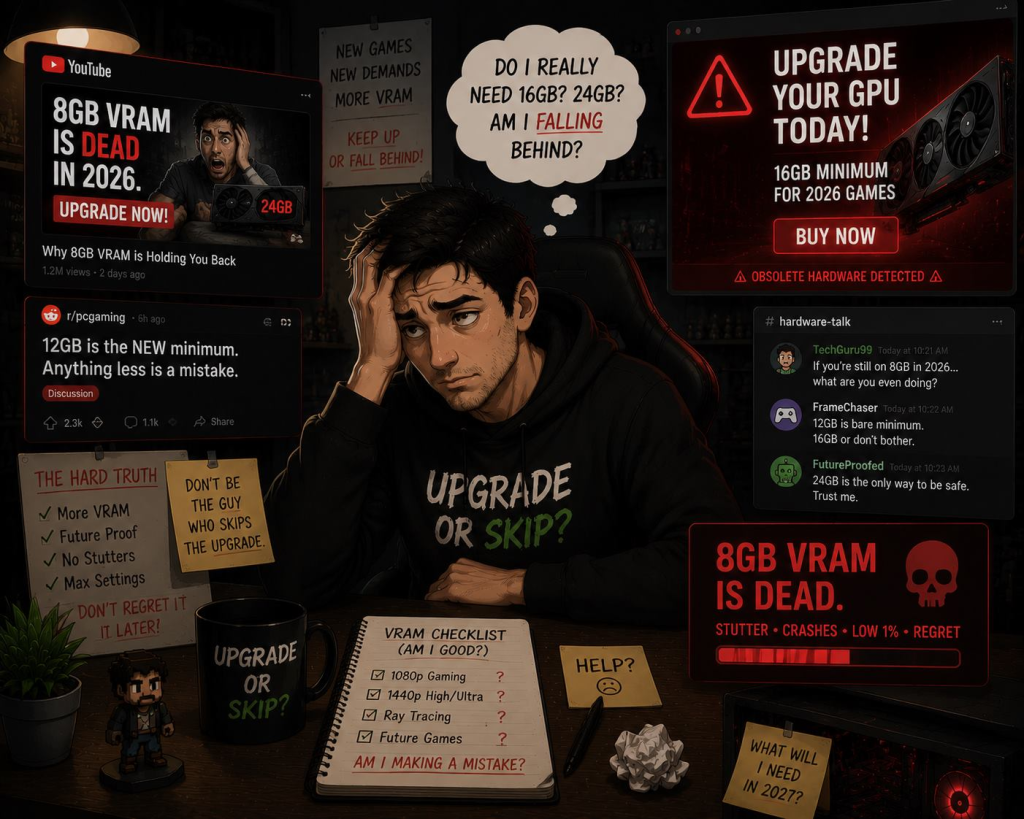
And if you have spent even five minutes in PC hardware discussions in 2026, you already know how it goes:
8GB is dead.
12GB is the new minimum.
16GB is safe now.
24GB is future-proof, bro, trust me.
At this point, your GPU is not a graphics card anymore.
It is a personality test.
I have been reading through Reddit discussions, YouTube benchmark comment sections, hardware forums, and review testing breakdowns.
Not as “official testing”, but as raw user feedback.
And the pattern is actually pretty consistent:
VRAM matters.
But the internet also loves turning anything related to performance limits into a buying panic.
VRAM Is Not Magic
VRAM is just memory.
It stores textures, frame data, ray tracing assets, and all the heavy visual junk modern AAA games throw at your GPU like it is unpacking a moving truck every time you load a new area.
When there is enough VRAM, everything feels normal.
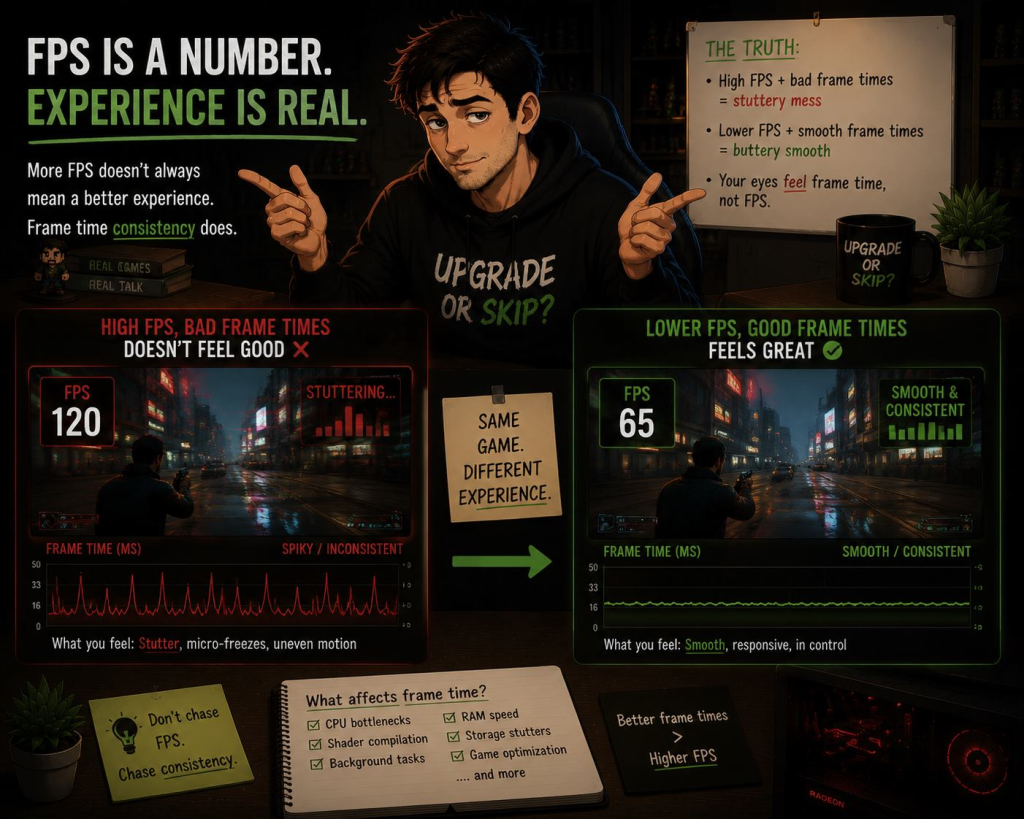
When there is not, you do not just get lower FPS.
You get worse problems:
- stuttering that feels random but isn’t
- texture pop-in like games forgot how loading works
- frame-time spikes that ruin control
- 1% lows collapsing in busy scenes
- “it runs fine” but feels broken
And here is the part most benchmark charts fail to communicate:
Average FPS is not the full story.
A GPU can show “70 FPS” and still feel like a slideshow when frame pacing collapses in real gameplay.
That is VRAM pressure.
Not GPU failure.
8GB VRAM: Still Alive, Just Not Comfortable Anymore
Let’s kill the drama first.
8GB is NOT dead.
But it is also no longer the relaxed default it used to be.
If you spend time in Reddit build threads, YouTube comments, or PC forums, you will notice something interesting:
Serious answers usually do not start with:
“Buy a new GPU.”
They start with boring questions:
- What resolution are you playing at?
- What game is actually the problem?
- Are you using Ultra textures just because they exist?
- Is ray tracing on?
- Are you actually running out of VRAM, or just guessing?
That is the uncomfortable truth:
A lot of “upgrade decisions” are not hardware problems.
They are settings problems.
8GB still works fine for:
- esports games
- older titles
- optimized shooters
- 1080p gaming with reasonable settings
But once you step into modern AAA games, high textures, 1440p, ray tracing, or heavy open-world titles…
8GB starts running out of breathing room.
Not dead.
Just constantly under pressure.
12GB VRAM: The “Stop Thinking About It” Tier
This is where things start to feel normal again.
12GB is not magic.
It will not fix a weak GPU.
But it removes a lot of unnecessary VRAM anxiety.
That alone is why people like it.
And in real-world discussions across Reddit users, YouTube breakdowns, and hardware community feedback, 12GB consistently shows up as the “no drama zone”.
This is also why cards like the RX 6700 XT aged better than expected.
Not because 12GB is future-proof.
But because it delays the point where VRAM becomes the main bottleneck.
12GB usually means:
- 1080p high settings without stress
- 1440p medium/high without constant tweaking
- high textures without instant VRAM warnings
- fewer unexplained stutters
- smoother long-term ownership
Even manufacturers shifting more SKUs toward 12GB tells you something:
This is not marketing.
It is adaptation.
16GB VRAM: Nice To Have, Easy To Overpay For
This is where people start overthinking.
Yes, 16GB is better.
No, it is not required for everyone.
It matters when you actually push your system:
- 1440p high refresh AAA games
- 4K gaming
- ray tracing-heavy titles
- heavily modded games
- creator workloads
- local AI workloads
- long-term GPU ownership
In those cases, 16GB gives breathing room.
Less stutter. Less tuning. Less “why does this feel off”.
But if you are at 1080p and your games already run smoothly, buying 16GB just because the internet said “8GB is dead” is how people end up upgrading perception instead of performance.
24GB VRAM: Useful, But Not A General Recommendation
Let’s be honest.
24GB VRAM is great.
For the right workloads.
AI, rendering, production pipelines, large datasets, professional creative work: yes, it matters.
But for gaming?
Most people do not need it.
They just like the idea of never having to think about VRAM again.
The problem is:
You do not buy “future-proofing.”
You buy a GPU today.
And today’s GPU still ages normally.
Sometimes VRAM lasts longer than the GPU core feels relevant.
That is not future-proofing.
That is just imbalance with a big number attached.
The Practical VRAM Breakdown
Here is the no-marketing version:
For 1080p gaming:
- 8GB: usable
- 12GB: comfortable
- 16GB: extra headroom
For 1440p gaming:
- 8GB: workable, but settings matter
- 12GB: sweet spot
- 16GB: safer long-term
For 4K gaming:
- 12GB: minimum
- 16GB: recommended
- 20GB+: ideal
For ray tracing:
- VRAM helps
- raw GPU power matters more
- do not rely on VRAM alone to fix performance
A VRAM-rich weak GPU is still a weak GPU.
No amount of memory changes that.

Upgrade If:
- Your current 8GB card stutters in games you actually play
- You are moving to 1440p or 4K
- You want high textures in modern AAA games
- Ray tracing is part of your actual experience
- You play heavily modded games
- You use creator tools or local AI workloads
- You plan to keep your next GPU for several years
Skip If:
- Your current games already feel smooth
- You mostly play esports, older, or lighter titles
- You are fine with High instead of Ultra
- You are upgrading because Reddit or YouTube said “8GB is dead”
- The new GPU looks better on paper but not in actual gameplay
- The upgrade does not solve a problem you can actually feel
The Upgrade or Skip Take
So how much VRAM do you really need in 2026?
For most gamers:
8GB is survival mode.
12GB is normal life.
16GB is comfort.
24GB is specialist territory.
But the real mistake is not choosing the wrong number.
It is treating VRAM like the whole GPU.
It is not.
It is one part of a system that got turned into a marketing battlefield because numbers are easy to sell, and fear is easier to sell.
VRAM matters.
But it does not decide everything.
And if your only reason for upgrading is:
“The internet said my GPU is dead.”
Then you are not upgrading hardware.
You are reacting to noise.
Next up:
Why Most Gamers Don’t Need a New CPU.
Because apparently now you need sixteen cores just to open Steam and argue on Discord.
Upgrade smarter. Skip louder.