
Disclosure: This post may contain affiliate links. If you buy through them, we may earn a small commission at no extra cost to you.
Welcome back to Upgrade or Skip.
In the last post, we talked about PC upgrades under $100 that actually make sense.
Small budget.
Daily improvement.
No marketing fireworks required.
Now we get to the darker sibling of budget upgrading:
The used GPU.
Buying a used graphics card sounds simple.
Someone else pays the early-adopter tax.
You get most of the performance for much less money.
Everybody wins.
At least that is the theory.
Lovely idea.
Unfortunately, reality usually comes with a few extra terms and conditions.
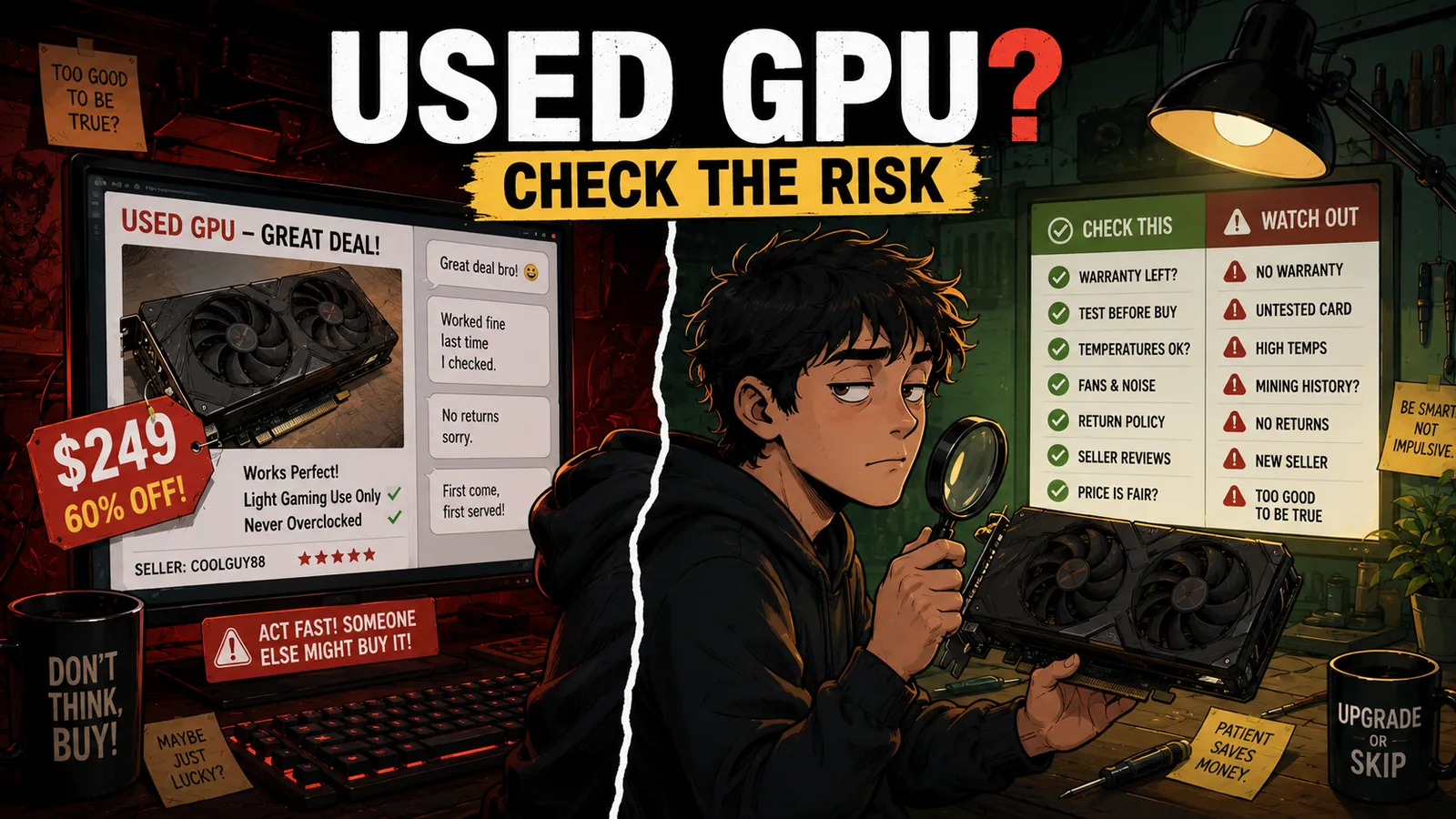
Used GPUs live in the same universe as missing warranties, tired fans, mystery mining history, fake listings, stripped cards, return scams, bad thermal pads, and sellers who describe every problem as:
“Worked fine last time I checked.”
Very reassuring.
Very Craigslist poetry.
A Used GPU Is Not Cheap. It Is Discounted Risk.
This is the first rule.
A used GPU is not automatically a good deal because it costs less than a new one.
It is cheaper because you are accepting something:
- Less warranty
- Less return protection
- Unknown history
- Older fans and thermal pads
- More testing responsibility
- More chance of a weird problem showing up later
That does not mean used GPUs are bad.
It means the discount needs to be real.
If a used card is only a little cheaper than a new card with a warranty, return policy, fresh fans, and no biography, that is not a deal.
That is buying someone else’s uncertainty at near-retail pricing.
The internet already has enough creative ways to separate people from their money.
You do not need to invent another one.
Why Used GPUs Look Tempting In 2026
Used GPUs are tempting because new GPU pricing continues to test everyone’s patience.
Based on 2026 price tracking, hardware reporting, retailer listings, and PC community discussions, the new GPU market remains volatile.
Memory costs, AI demand, limited availability, and shifting product stacks can all push new cards well beyond what many people expected to pay.
That makes used cards look more attractive.
Not always because used prices are amazing.
Sometimes because new prices are simply rude.
When a new midrange card costs more than your entire sense of financial dignity, a used last-generation card starts whispering.
And sometimes that whisper is completely reasonable.
A used GPU can make sense if it gives you a meaningful performance jump while leaving enough room to compensate for the risk.
A carefully purchased used card can be the difference between staying stuck and finally enjoying smooth 1080p or 1440p gaming without buying into launch-day nonsense.
But “can make sense” is doing a lot of work there.
The Discount Has To Be Big Enough
The price gap is the whole argument.
If a used GPU costs only 20% less than a comparable new card, I become suspicious.
Maybe it works.
Maybe the seller is local.
Maybe the card is clean.
Maybe the warranty transfers.
Maybe you can test it first.
Maybe.
But most of the time, that discount is not enough.
You are giving up certainty.
That discount needs to pay for it.
The lower price should compensate for the things you cannot see:
- Fan wear
- Heat history
- Dust
- Repaste risk
- Coil whine
- Previous overclocking
- No easy return
- The possibility that “light gaming use” actually meant running the card inside a case with the airflow of a sealed drawer
If the discount does not compensate for those risks…
Skip it.
New hardware is not always the better value.
But warranties have value.
Return policies have value.
Not wondering whether your GPU spent two years mining cryptocurrency inside somebody’s garage has value.
Mining History Is Not The Only Problem
People love asking whether a GPU was used for mining.
That is a fair question.
It is not the only question.
A mining card can be perfectly fine if it was undervolted, kept cool, cleaned regularly, and maintained properly.
A “gaming only” card can be awful if it spent years overheating inside a dusty case while its fans screamed for mercy every evening.
Do not reduce the entire decision to mining.
Ask about the overall condition.
Ask about temperatures.
Ask about fan noise.
Ask whether the card has been opened.
Ask whether the original box still exists.
Ask whether the receipt still exists.
Ask whether any warranty remains.
Ask whether you can actually see the card running.
“Never mined.”
is not a health certificate.
It is simply one answer.
Sometimes useful.
Sometimes almost meaningless.
The Scams Are Real
The used GPU market has always had risks.
In 2026, those risks are not theoretical.
Recent hardware reporting has documented fake or gutted graphics cards, suspicious open-box returns, modified mobile GPUs sold as desktop products, missing VRAM chips, missing cores, and listings that become dramatically less attractive the moment they arrive at your door.
That does not mean every used GPU seller is trying to scam you.
Most people are probably just trying to fund their next questionable hardware purchase.
But expensive GPUs attract creative nonsense.
And some of that nonsense is genuinely impressive.
If the deal looks too good…
Slow down.
If the photos are blurry…
Slow down.
If the seller refuses testing…
Slow down.
If the price looks impossible…
Slow down.
If the listing keeps repeating phrases like:
“Untested.”
“No returns.”
“Should work.”
“For parts.”
Stop romanticizing.
That is not a bargain.
That is a warning label doing cardio.
Where You Buy Matters
The platform matters almost as much as the GPU itself.
A local purchase can be excellent if you can inspect the card, test it, and avoid shipping damage.
It can also become terrible the moment the seller disappears forever.
Online marketplaces may provide buyer protection.
They may also provide return headaches, swapped products, fake listings, and customer support departments apparently trained by brick walls.
A used GPU from a reputable retailer or an official refurbished program usually costs a little more.
Sometimes that extra cost is worth every dollar.
You are not only buying a graphics card.
You are buying your exit strategy if something goes wrong.
That strategy has value.
Avoid Buying On Emotion
One more thing.
If you suddenly feel like you have to buy a used GPU before someone else does…
Slow down.
Fear of missing out is not evidence that a GPU is worth buying.
A good deal survives five minutes of thinking.
A bad deal usually demands an immediate decision.
The seller’s urgency is not automatically your emergency.
What To Check Before Buying
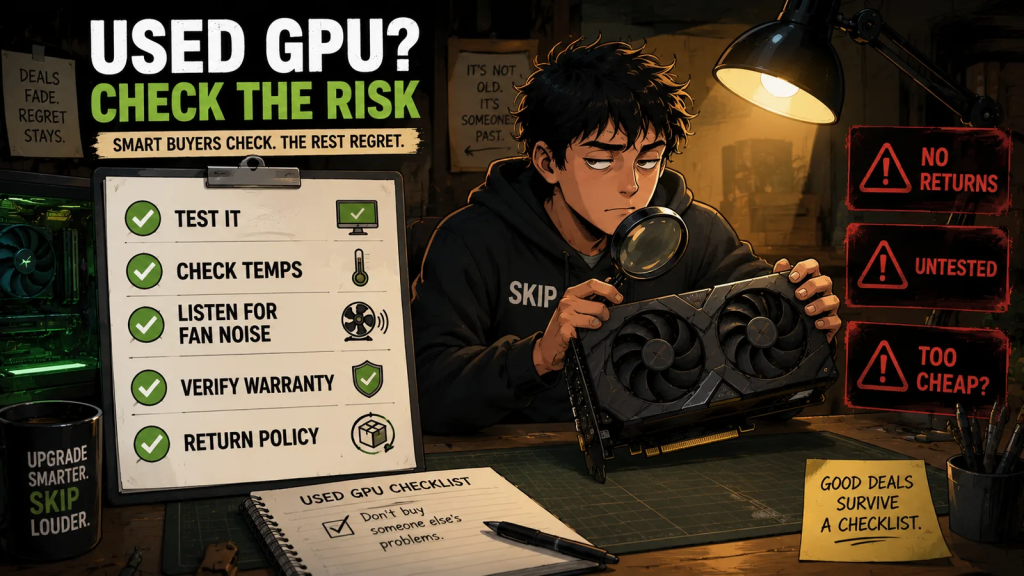
Before buying a used GPU, get boring.
Boring protects money.
Ask for:
- Clear photos of the actual card
- Photos of the ports, fans, cooler, and backplate
- A screenshot showing the card detected correctly
- Recent benchmark or stress-test results
- Temperature numbers under load
- Confirmation of whether the card has been opened
- The original receipt or proof of purchase, if available
- Remaining warranty details
- Return terms or buyer protection
If you’re buying locally, test the card before handing over your money whenever possible.
Look for:
- Artifacting
- Crashes
- Fan rattling
- Burn marks
- Corrosion
- Missing screws
- Damaged ports
- Strange BIOS behavior
- Temperatures that look unreasonable
You do not need to become a repair technician.
You do need to avoid buying somebody else’s problem with a cooler attached.
Do Not Buy At The Edge Of Your Budget
This is where people get trapped.
They spend their entire budget on the used GPU and leave no room for the boring consequences.
Maybe the card needs fresh thermal paste.
Maybe your power supply is no longer enough.
Maybe the GPU is too long for your case.
Maybe you need different power cables.
Maybe your monitor cannot properly show the improvement.
Maybe the card runs hotter than expected and your airflow needs work.
Maybe the seller’s definition of “quiet” and yours are completely different.
Used GPU buying works best when you leave yourself a little breathing room.
If the card consumes every dollar you have, the first unexpected problem immediately becomes a financial problem.
That is not a deal.
That is financial parkour.
A Used GPU Makes Sense When The Jump Is Obvious
Do not buy a used GPU for a tiny upgrade.
This is where spec-sheet shopping traps people.
Moving from one midrange GPU to another slightly newer midrange GPU often costs more money than it saves frustration.
The improvement should be obvious.
You should be able to explain it without opening three benchmark charts and a Reddit argument.
For example:
- Better 1440p performance
- More VRAM for the games you actually play
- Better power efficiency
- Lower noise
- Better driver or feature support
- A genuine move away from settings compromises that bother you
If the upgrade only looks impressive after several benchmark charts and a long comment thread…
Wait.
A used GPU should solve a real problem.
Not replace one anxiety with another.
Upgrade If:
- The used GPU is meaningfully cheaper than comparable new options.
- You can test the card or buy with strong buyer protection.
- The performance jump is obvious for your games, monitor, and settings.
- The card has enough VRAM for your actual workload.
- The seller provides clear photos and reasonable answers.
- Your power supply, case, airflow, and monitor all support the upgrade.
- You still have room in your budget for small surprises.
Skip If:
- The used price is only slightly lower than buying new.
- The seller refuses testing or avoids simple questions.
- The listing says “untested” and you are not comfortable losing money.
- There is no buyer protection and no realistic return option.
- The deal looks too good to be true.
- You are upgrading only because newer GPUs made your current one feel old.
- You cannot clearly explain what problem this GPU will solve.
The Upgrade or Skip Take
Should you buy a used GPU in 2026?
Maybe.
Helpful answer, I know.
But it is also the honest one.
A used GPU can be one of the smartest upgrades in an expensive market.
It can deliver real gaming performance without paying launch pricing, especially when new cards are overpriced, difficult to find, or awkwardly positioned.
It can also be an excellent way to purchase someone else’s heat, dust, fan noise, missing warranty, and unresolved life choices.
The difference is not courage.
The difference is price.
Testing.
Protection.
Patience.
Diagnosis.
Buying used is not about being brave.
It is about being patient.
Do not buy used because you feel behind.
Buy used only when the discount is large enough, the risk is controlled enough, and the performance jump is obvious enough.
Otherwise…
Skip it.
The best used GPU is not the cheapest one.
It is the one that still works long after the seller has stopped replying.
Next up:
Why Benchmark Charts Don’t Tell the Whole Story
Because numbers are useful.
But they are not your gaming experience.
Upgrade smarter. Skip louder.