
Welcome back to Upgrade or Skip.
In the last post, we talked about when an upgrade actually makes sense.
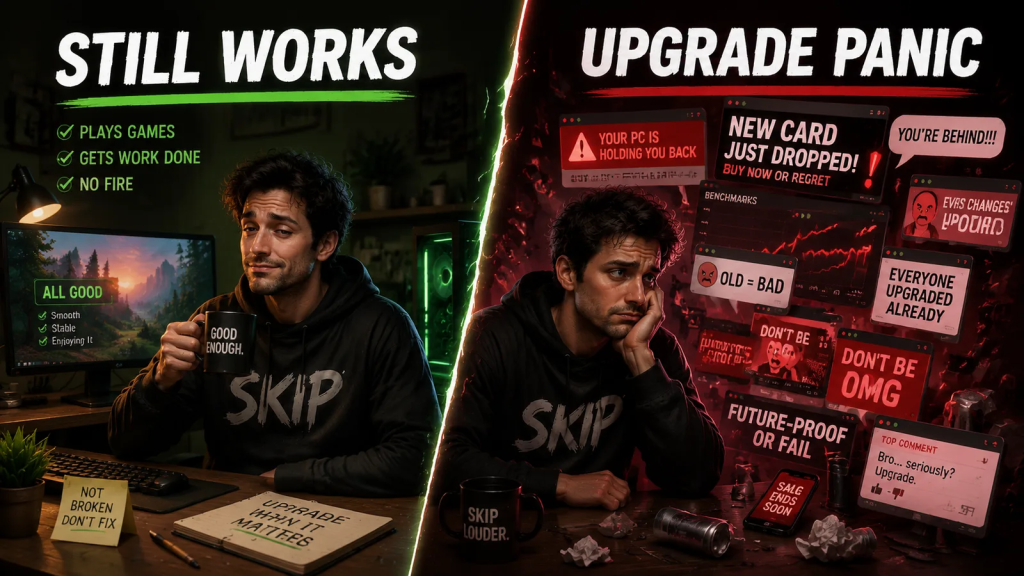
Today we need to talk about the thing that makes people upgrade when it doesn’t.
Upgrade anxiety.
That little voice that shows up right after you build a PC, buy a GPU, install more RAM, or finally convince yourself your setup is fine.
Then you open Reddit.
Or YouTube.
Or a benchmark chart.
Or one extremely confident comment from a stranger with a graphics card avatar.
And suddenly your perfectly usable machine starts feeling like a personal failure.
Very normal.
Very healthy.
Definitely not what marketing departments want you to feel every six months.
What Upgrade Anxiety Looks Like
Upgrade anxiety usually starts small.
A game stutters once.
A new GPU launches.
Someone posts a benchmark where your card is suddenly “37% slower” than something that costs more than your entire build.
A YouTube thumbnail declares your PC is dead.
A Reddit thread calls your CPU “ancient.”
A Quora answer insists you should always buy the newest thing for performance.
And suddenly you’re no longer asking:
“Does my PC still do what I need?”
You’re asking:
“Am I falling behind?”
That’s the trap.
Because those are not the same question.
One is practical.
The other is panic wearing a shopping cart
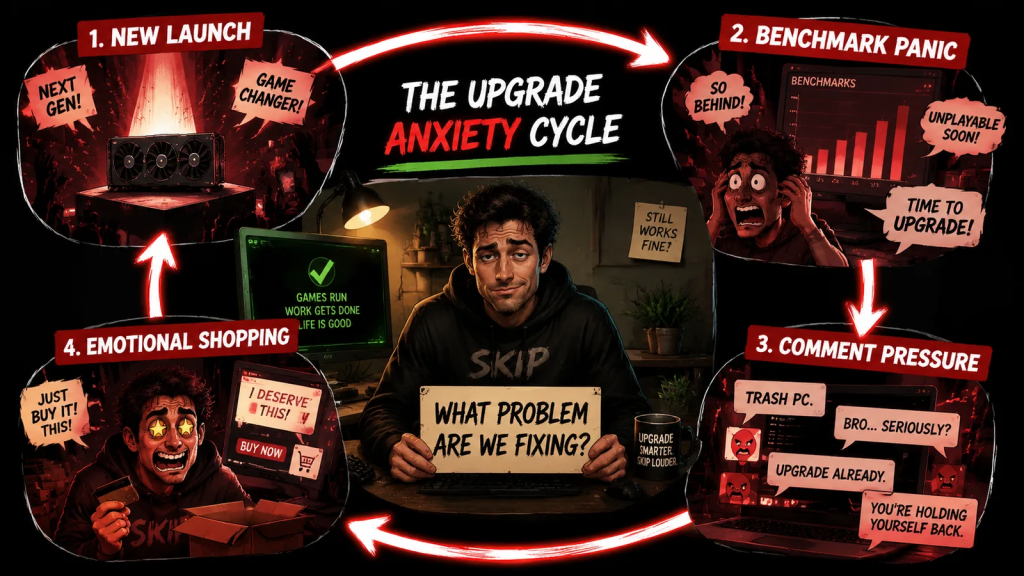
The Cycle Is Always The Same
The upgrade anxiety cycle usually goes like this:
First, you feel fine.
Your games run.
Your work gets done.
Nothing is on fire.
Then a new product launches.
Suddenly the thing you were happy with yesterday becomes “mid.”
Then the comparison starts.
More cores.
More VRAM.
More cache.
More bandwidth.
More AI features.
More FPS in games you don’t even play.
Then comes the fear.
What if my PC is obsolete?
What if future games need more?
What if I regret not upgrading now?
What if everyone else is moving on?
Then comes the shopping.
Not because your system stopped working.
Because your confidence did.
That’s the cycle.
And the tech industry is very good at feeding it.
New Hardware Makes Old Hardware Look Worse
New hardware is supposed to be better.
That’s the point.
A new GPU should beat an old GPU.
A new CPU should outperform older chips.
A new SSD should look impressive on paper.
Breaking news: newer product is faster than older product.
Science continues.
But the mistake is treating “better exists” as the same thing as “I need better.”
Those are different.
A 2026 flagship GPU being faster doesn’t make your current GPU useless.
A new X3D CPU topping benchmarks doesn’t mean your six-core chip forgot how to run games.
A 32GB RAM recommendation doesn’t mean every 16GB system belongs in the trash.
New hardware raises the ceiling.
It does not automatically change your needs.
Benchmarks Are Useful, But Also Dangerous
Benchmarks are not bad.
They are useful.
They show performance differences, scaling behavior, and bottlenecks.
But they are also very good at making normal people feel behind.
A benchmark chart does not know your monitor.
It does not know your games.
It does not know your settings.
It does not know whether you care about 240 FPS, ray tracing, modded Skyrim, video editing, or just playing something after work without turning your hobby into a spreadsheet.
A benchmark shows what can happen.
It does not decide what matters.
That part is yours.
The Internet Turns Every Gap Into A Crisis
If you spend time in PC communities, you see the pattern.
Someone asks if their build is still fine.
Replies split instantly into two camps.
One camp asks useful questions:
What resolution?
What games?
What FPS target?
What settings?
What budget?
What problem are you actually solving?
The other camp says:
Upgrade.
Very fast.
Very confident.
Very wallet-shaped.
This is how upgrade anxiety spreads.
Because a lot of advice starts from comparison, not need.
Your system is compared to newer systems.
Your GPU is compared to newer GPUs.
Your CPU is compared to leaderboard chips.
Your experience gets compared to someone else’s ideal graph.
That’s not always helpful.
Sometimes it’s just performance FOMO with extra steps.
Even Enthusiasts Don’t Upgrade Constantly
Here’s the funny part.
Even PC enthusiasts don’t upgrade as often as the internet suggests.
Across PC communities, you see the same pattern again and again: plenty of people keep gaming PCs for several years, often 3–5 years or more, before changing major parts. The immediate-upgrade crowd is loud, but it is not the whole market.
That matches reality.
Most people are not rebuilding their PC every launch.
The internet just amplifies the loudest upgrade voices.
They are not the average.
They are just louder.
And probably checking GPU prices again.
Upgrade Anxiety Loves Vague Words
The most dangerous upgrade advice usually comes with vague terms:
Future-proof.
Next-gen ready.
AI-ready.
Bottleneck.
Minimum spec.
Holding you back.
Obsolete.
Some of those words mean something.
Most of the time, they are used like smoke machines.
They create atmosphere.
Not clarity.
“Future-proof” sounds smart until you ask:
Future for what?
1080p esports?
1440p AAA?
4K ray tracing?
Video editing?
Local AI workloads?
Five years of Chrome tabs and Discord arguments?
Different futures need different hardware.
Without defining the future, “future-proof” just means:
Spend more money and hope.
That’s not strategy.
That’s anxiety with branding.
The Cure Is Specificity
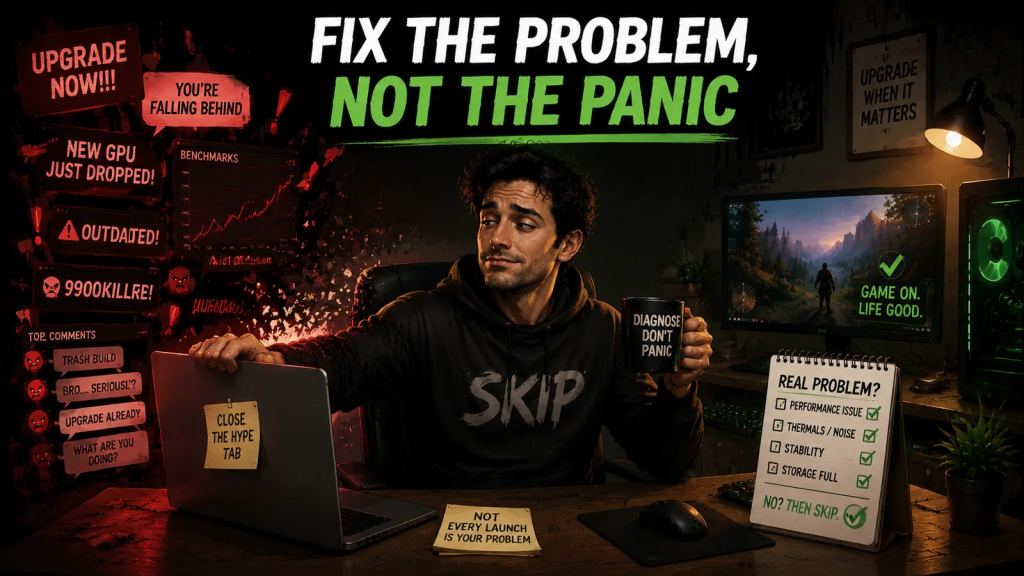
The best way to kill upgrade anxiety is specificity.
Ask:
What exactly feels bad?
Which game or workload?
What resolution?
What FPS do I actually want?
What settings am I willing to lower?
Is this everywhere or just one poorly optimized game?
Have I checked thermals, drivers, RAM, VRAM, storage, background apps?
Will this upgrade fix something I can actually feel?
That last question matters most.
If the answer is no, wait.
There is no reward for upgrading early.
Nobody sends you a certificate for replacing working hardware before it becomes a problem.
When The Anxiety Is Actually A Signal
Upgrade anxiety is not always wrong.
Sometimes it points to a real issue.
If your GPU cannot handle the games you actually play, that matters.
If your CPU destroys your 1% lows in real workloads, that matters.
If 16GB RAM is constantly maxed out, that matters.
If your SSD is failing, don’t overthink it. Replace it.
The problem is not upgrading.
The problem is upgrading before diagnosis.
A real upgrade starts with evidence.
A panic upgrade starts with a comment section.
Try not to let the comment section manage your wallet.
Upgrade If:
- Your system repeatedly fails at tasks you actually do.
- The problem appears across multiple games or workloads.
- Basic fixes and settings changes do not help.
- You can clearly identify the bottleneck.
- The upgrade improves real experience, not just numbers.
- Stability or reliability is at risk.
- The price makes sense for the gain.
Skip If:
- Your system already feels fine.
- You are reacting to a launch, chart, or comment thread.
- You cannot define the actual problem.
- The upgrade only improves numbers you don’t feel.
- The issue exists in one poorly optimized game.
- You haven’t checked settings, thermals, or drivers.
- You are buying “future-proof” without knowing the future.
The Upgrade or Skip Take
Upgrade anxiety is profitable.
That’s why it never disappears.
There will always be a new GPU.
A new CPU.
A new spec sheet.
A new benchmark chart designed to make your system look tired under fluorescent lighting.
But your job is not to keep up.
Your job is to understand when your experience actually needs help.
Sometimes the answer is upgrade.
Sometimes the answer is wait.
And sometimes the answer is close YouTube, stop reading comment sections, launch the game, and remember:
your PC was fine before the internet told you otherwise.
Next up:
The Best PC Upgrades Under $100 That Actually Make Sense.
Because not every improvement needs financial damage.
Upgrade smarter. Skip louder.