
Welcome back to Upgrade or Skip.
In the last post, we talked about the hidden cost of chasing Ultra settings.
Because nothing says “smart PC ownership” like spending several hundred dollars so a puddle can look slightly more emotionally damaged.
Today we move to one of the most overused phrases in PC hardware:
Future-proof.
The sacred promise.
The magical excuse.
The two-word spell that turns a reasonable $900 build into a $2,400 shopping cart with emotional-support RGB.
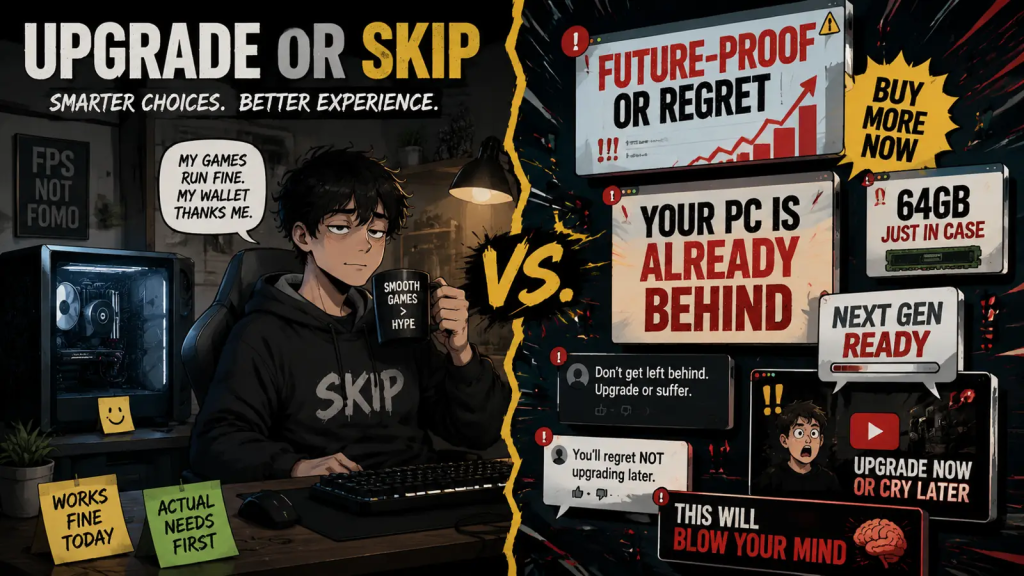
If you spend enough time in Reddit build threads, YouTube comments, PCMR posts, or random Discord PC channels, you will see the same pattern again and again:
Someone posts a build.
Top comment:
“Why not just get the better CPU for future-proofing?”
Second comment:
“Bro, 32GB RAM is minimum now.”
Someone else replies:
“8GB VRAM is already dead, don’t do it.”
And then one person calmly says:
“Honestly, you’ll probably upgrade again in two years anyway.”
Nobody agrees.
Everyone is confident.
Very healthy environment.
Future-Proof Is Not A Real Spec
You can buy a CPU.
You can buy a GPU.
You can buy RAM.
You can buy storage.
You can buy a PSU, motherboard, cooler, case, monitor, keyboard, mouse, and enough fans to make your room sound like a small airport.
But you cannot buy “future-proof.”
It is not a spec sheet line.
It is not a benchmark score.
It is not a warranty against regret.
It is a guess.
Sometimes a good one.
Sometimes an expensive horoscope.
The future changes.
Games change.
Engines change.
Resolutions change.
APIs change.
Prices change.
Your needs change.
And that last one is the part people forget.
The PC you think you are building for the future may not match the future you actually end up living in.
Maybe you buy a 4K-ready monster and then mostly play esports titles.
Maybe you buy a giant CPU and then stay GPU-limited for years.
Maybe you buy 64GB of RAM and your heaviest workload is Steam, Discord, Chrome, and a mild sense of panic.
Congratulations.
You did not future-proof.
You bought expensive comfort.
There Are Two Kinds Of Future-Proofing
This is where the discussion needs to split.
Because not all future-proofing is nonsense.
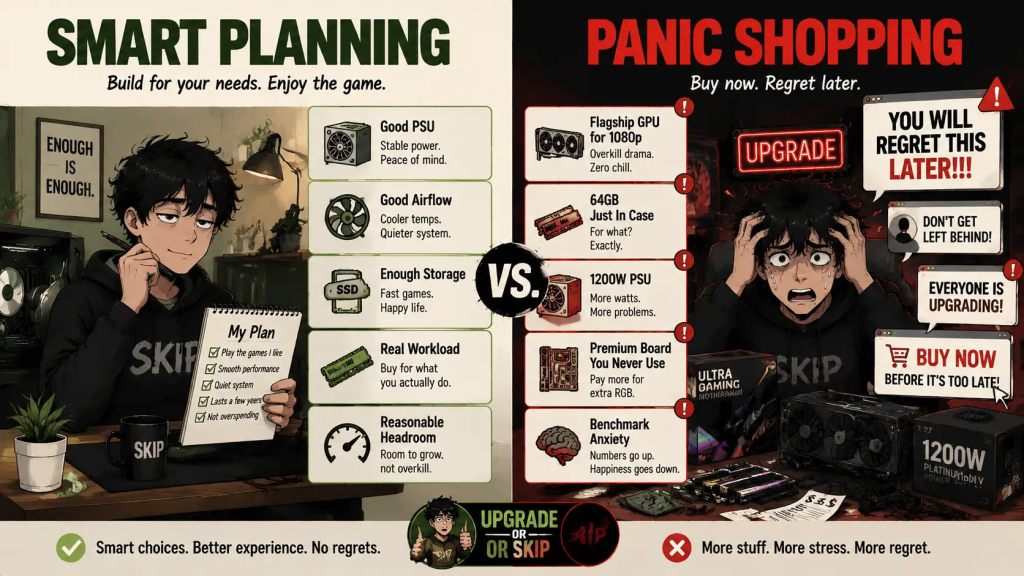
There is smart planning.
And then there is panic shopping.
Smart Planning
- buying a quality PSU
- choosing a case with good airflow
- getting enough storage headroom
- choosing a motherboard with the ports and slots you actually need
- buying 32GB RAM if your workload justifies it
- getting a GPU with enough VRAM for your resolution
- avoiding bottom-tier parts that will annoy you later
This is practical.
This is boring.
This is usually good.
Panic Shopping
- buying a flagship GPU for 1080p because “future”
- buying 64GB RAM “just in case”
- buying a monster CPU with no real workload
- overspending on a motherboard you will never use properly
- buying a 1200W PSU for a mid-range system
- upgrading everything because a benchmark chart looked scary
That is not future-proofing.
That is anxiety with a checkout button.
The Community Version Is Even Funnier
The industry loves the word “future-proof” because it sounds responsible.
But the community uses it too.
And sometimes it becomes a group decision-making bug.
A typical build thread:
User:
“I just want a smooth 1440p gaming PC.”
Reply 1:
“Spend more on the GPU for longevity.”
Reply 2:
“Get more RAM because games are getting heavier.”
Reply 3:
“Upgrade the PSU for headroom.”
Reply 4:
“Better motherboard for upgrade path.”
Reply 5:
“At that point, just get the higher-end CPU.”
Three comments later, the budget is gone.
Nobody asks what games are being played anymore.
That is how “future-proof” turns into group-funded wallet damage.
Future-Proof For What?
Are you trying to future-proof for:
- 1080p esports?
- 1440p high refresh?
- 4K gaming?
- ray tracing?
- path tracing?
- VRAM-heavy AAA games?
- modded games?
- video editing?
- streaming?
- AI workloads?
- a 3-year upgrade cycle?
- a 6-year lifespan?
These are not the same future.
A “future-proof” esports PC and a “future-proof” 4K ray tracing PC are not the same machine.
If you cannot define the future you are preparing for, you are not planning.
You are just spending more and hoping the word protects you.
It will not.
GPU Future-Proofing Is Where The Fear Lives
GPU future-proofing is the biggest trap.
Because people try to buy certainty in an uncertain market.
“I’ll spend more now so I don’t upgrade later.”
Sometimes that works.
Often it just means you paid today’s premium for tomorrow’s unknowns.
A faster GPU can last longer.
More VRAM can help.
But GPUs age in messy ways:
- new games get heavier
- ray tracing demands increase
- upscaling expectations change
- features shift
- driver priorities move
- your monitor changes
- your standards change
Sometimes your GPU is still strong, but the baseline expectation moves anyway.
Sometimes YouTube thumbnails start holding a funeral for it every six months.
Very normal ecosystem.
CPU Future-Proofing Is Usually Overestimated
CPU future-proofing sounds responsible because cores feel like safety.
Eight cores.
Twelve cores.
Sixteen cores.
And yes, some workloads need that.
But for most gaming use cases:
A good mid-range CPU often lasts longer than people expect.
Benchmarks often exaggerate differences under ideal CPU-limited conditions:
- low resolution
- high-end GPU
- max FPS chasing
Useful data.
But not always your reality.
RAM Future-Proofing Depends On Reality
RAM threads never die.
They just evolve.
One year: 16GB is enough.
Next year: 32GB is “safe.”
Then someone opens Chrome + Discord + Steam + YouTube and declares 64GB mandatory.
Both sides argue forever.
Here is the boring truth:
- 16GB still works for many gaming systems
- 32GB is a reasonable modern comfort zone
- 64GB is for specific workloads, not default gaming
Empty space is not performance.
Motherboard Future-Proofing Is Emotional
“This board has upgrade path.”
Maybe.
But be honest:
Are you actually going to upgrade later?
Or are you just buying expensive reassurance?
Motherboards are worth paying for when they improve real things:
- stability
- power delivery
- BIOS support
- ports
- storage
- networking
- usability
Not imaginary CPU upgrades that may never happen.
The Best Future-Proof Parts Are Usually Boring
The real long-term value is not flashy:
- quality PSU
- good airflow case
- enough storage
- reliable cooling
- decent monitor
- enough RAM for real use
These parts survive multiple upgrades.
They don’t look exciting.
But they quietly outlive everything else.

The $4,000 Cart Problem
It always starts simple:
“I just want a gaming PC that lasts.”
Then:
Better GPU
Better CPU
More RAM
Bigger SSD
Better PSU
Better motherboard
Better cooler
New monitor
Now it is no longer about needs.
It is about avoiding regret.
And regret is expensive.
What Future-Proofing Should Actually Mean
Not:
“Buy the most expensive version of everything.”
But:
“Buy parts that match your real use case with reasonable headroom.”
If you cannot answer:
- what you actually play
- what resolution you use
- how long you will keep the system
- what actually bothers you
Then “future-proof” is not a plan.
It is just a justification.
Upgrade If:
- Your current PC no longer matches your real needs
- You are moving to higher resolution or workload
- You can identify the bottleneck
- The upgrade improves real experience, not just benchmarks
- You are buying durable parts (PSU, case, storage, monitor)
- The budget stays healthy
- You know what future you are building for
Skip If:
- You are guessing your future needs
- You are reacting to online panic
- Your system already works fine
- The upgrade only improves charts
- You are buying “safety feeling”
- You cannot explain the problem being solved
The Upgrade or Skip Take
Future-proofing is not fake.
But it is often misunderstood.
A good build prepares for tomorrow.
A bad build overpays for imaginary problems today.
The difference is clarity.
Because the future does not become safer just because your cart gets more expensive.
Sometimes the smartest “future-proof” choice is simple:
Buy what you need. Leave reasonable headroom. Ignore the noise.
Next up:
When an Upgrade Actually Makes Sense.
Because yes, sometimes the answer really is to buy the thing.
Just not every time a YouTube thumbnail starts yelling.
Upgrade smarter. Skip louder.