
The most common PC upgrade panic might not be a real problem.
Welcome back to Upgrade or Skip.
In the last post, I said your PC might not be obsolete.
Your expectations may have changed.
Or, more likely, they may have been changed for you by benchmarks, thumbnails, spec sheets, and the usual internet choir yelling that everything you own is now embarrassing.
So let’s start turning that idea into actual buying decisions.
First target:
RAM.
Specifically, the question that keeps showing up in PC-building discussions like a recurring Windows update:
Is 16GB RAM still enough in 2026?
Short answer:
Yes.
Longer answer:
Yes, but stop pretending it means the same thing it meant five years ago.
16GB is not dead.
It is not the new 8GB.
It is not a crime against gaming.
But it is also no longer the automatic “don’t worry about it” answer for every PC.
That job is slowly moving toward 32GB.
Annoying?
Yes.
Surprising?
Not really.
The Internet Wants a Simple Answer
PC hardware discussions love turning everything into a war.
The truth is less dramatic.
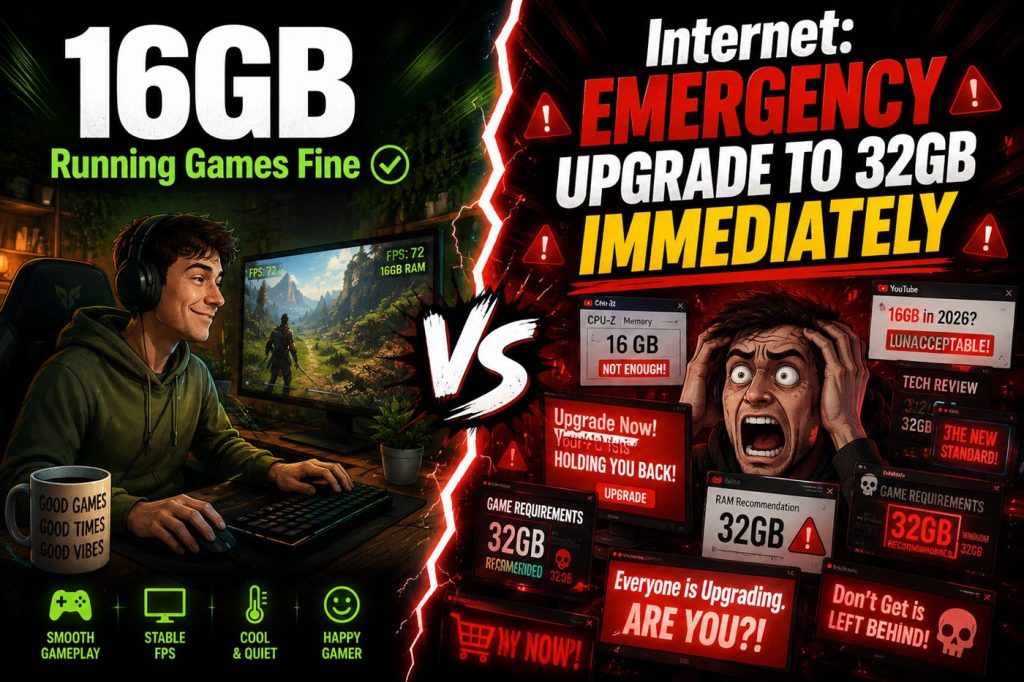
For a lot of people, 16GB of RAM still works fine.
If you are mostly gaming, browsing, watching videos, writing, studying, using office apps, and doing normal everyday computer things, 16GB is still perfectly usable.
Not luxurious.
Not bulletproof.
But usable.
Many recent gaming tests have shown that a surprising number of modern games still perform very similarly with 16GB and 32GB of system memory.
That does not mean 32GB is useless.
It means the phrase “16GB is dead” is doing what the internet does best:
Taking a real trend and turning it into a panic button.
16GB Is Now the Baseline, Not the Flex
This is the real shift.
A few years ago, 16GB felt comfortable.
In 2026, 16GB feels like the practical starting point.
That is a very different sentence.
It means you can still use it.
It also means you should stop treating it like a luxury specification.
The problem is not that 16GB suddenly stopped working.
The problem is that modern PCs are messier now.
Games are bigger.
Browsers are hungrier.
Discord apparently wants to become a small operating system.
Launchers, overlays, RGB software, cloud-sync apps, capture tools, and background services all want memory.
At some point, 16GB stops feeling like 16GB.
It starts feeling like 16GB shared with twelve roommates.
Gaming: Still Fine, With Conditions
For gaming alone, 16GB is still enough more often than the panic merchants want to admit.
If you close unnecessary background apps and play at reasonable settings, many games still run perfectly well.
That is the boring answer.
And boring answers rarely go viral.
The caveat is that some games are getting heavier.
Open-world games.
Simulation games.
Heavily modded games.
Poorly optimized games.
All of them can push beyond what 16GB handles comfortably.
So the honest answer is simple:
16GB is still enough for many games.
32GB is better for fewer headaches.
That is not as exciting as declaring 16GB dead, but it is much closer to reality.
Multitasking Is Where 16GB Gets Tired
The real problem is not always the game.
It is everything around the game.
You are not just playing anymore.
You have Chrome open.
Discord open.
Spotify open.
Steam open.
Maybe OBS.
Maybe a YouTube guide because the game has a crafting system designed by someone who hates free time.
Maybe a second monitor.
Maybe twenty browser tabs.
That is where 16GB starts sweating.
Not because it is unusable.
Because modern “just gaming” is rarely just gaming.
This is why 32GB often feels better.
Not necessarily faster.
Just calmer.
Fewer stutters.
Less tab-closing.
Less SSD swapping.
Sometimes the upgrade is not about making the game faster.
Sometimes it is about making the entire PC stop acting like it is balancing plates.
16GB RAM Is Not the New 8GB
Let’s kill this myth properly.
No, 16GB is not the new 8GB.
8GB is where the real pain begins.
Modern Windows.
Modern browsers.
Modern games.
Modern multitasking.
None of them are especially kind to 8GB anymore.
16GB is different.
It is still a working baseline.
You can game on it.
Work on it.
Study on it.
Live with it.
You may simply need to be a little more aware of what else is running.
So when somebody says:
“16GB is basically 8GB now.”
They are probably trying to win an argument, not help you spend money wisely.
The Single-Stick Problem
Not all 16GB setups are equal.
A PC with 2×8GB sticks running in dual-channel memory is usually better than a PC with one lonely 16GB stick.
Dual-channel memory can improve performance in certain games and CPU-limited situations.
So before upgrading, check what you already have.
If you have 2×8GB:
Great.
If you have 1×16GB:
Adding a second matching stick may be one of the easiest upgrades you can make.
DDR4 vs DDR5: Do Not Let the Sticker Bully You
If you are on an older DDR4 platform, do not panic just because DDR5 exists.
DDR5 is newer.
That does not mean your DDR4 system instantly became office furniture.
For many older PCs, upgrading from 16GB DDR4 to 32GB DDR4 can be one of the most sensible upgrades available.
Not glamorous.
Not exciting.
Nobody is making a cinematic trailer about adding more RAM.
But useful?
Absolutely.
And useful upgrades are usually better than flashy ones.
Upgrade If
Upgrade from 16GB to 32GB if:
- You regularly run out of memory.
- Your games stutter while RAM usage is near full.
- You play heavily modded, simulation, or open-world games.
- You stream or record while gaming.
- You use video editing, coding, virtual machines, or AI tools.
- You constantly multitask with many apps open.
- You are building a new PC and the price difference is reasonable.
- You simply want a smoother overall experience.
Those are real reasons.
Not fear reasons.
Not Reddit reasons.
Real ones.
Skip the Upgrade If
You can probably stay on 16GB if:
- Your current games run smoothly.
- You mostly play esports titles or older AAA games.
- You do not stream or record gameplay.
- You close background apps before gaming.
- Your PC is mainly for browsing, school, office work, and media.
- RAM prices are unusually high where you live.
- The money would be better spent elsewhere.
That last point matters.
If your GPU is weak, your SSD is tiny, or your monitor is terrible, RAM may not be the first place to spend money.
The upgrade should solve the actual problem.
Not just the loudest one.
New Builds Are Different
If you are building a brand-new gaming PC in 2026, I would generally try to start with 32GB if the budget allows.
Not because 16GB is unusable.
Because new builds should avoid obvious near-future friction when possible.
A 2×16GB kit gives you room for modern games, multitasking, and future software bloat pretending to be innovation.
That said, if your choice is:
16GB RAM + a better GPU
or
32GB RAM + a weaker GPU
I would not automatically choose the RAM.
For most gaming PCs, the GPU still matters more.
Final Verdict
So, is 16GB RAM still enough in 2026?
Yes.
For many people, it is still enough.
But it is no longer the comfortable recommendation it once was.
16GB is the practical baseline.
32GB is the comfort zone.
8GB is where patience goes to die.
If your PC feels fine today, do not upgrade just because the internet discovered a new minimum standard to scream about.
Skip the panic.
But if your games are stuttering, your multitasking is messy, or your work genuinely benefits from more memory, then 32GB can be one of the cleanest upgrades you can make.
Not because marketing said so.
Because your actual use case earned it.
The goal is not to chase bigger numbers.
The goal is to solve real problems.
Upgrade because you need to.
Not because the internet got louder.
Next Up
Do You Really Need a New GPU, or Just Lower Your Settings?
Because sometimes the problem is not your hardware.
Sometimes it is Ultra settings wearing a fake mustache.
Upgrade smarter. Skip louder.